Biography

Sebs

Dr. Ioan-Sebastian Buhai is an economist whose research interests span Microeconometrics, Labour Economics, Industrial Organization, and Applied Microeconomics broadly conceived. Born in Cluj-Napoca, Transylvania (Romania), Dr. Buhai holds a PhD and MPhil in Economics from the Tinbergen Institute and Erasmus University Rotterdam, as well as dual undergraduate degrees from University College Utrecht, Utrecht University: a BSc in Sciences (Mathematics & Theoretical Physics) and a BA in Social Sciences (Economics, Law, & Political Sciences).

He currently has principal affiliations with Pontificia Universidad Católica de Chile (UC Chile) – Institute of Economics, Stockholm University – Swedish Institute for Social Research (SOFI), and University of Minho – Centre for Research in Economics and Management (NIPE). Over the course of an unusually international career, he has held prior long-term and visiting positions at several other prestigious institutions, including the Center for Economics Research and its Applications (CEPREMAP) in Paris, Einaudi Institute for Economics and Finance (EIEF) in Rome, Northwestern University, the Chicago Fed, Aarhus University, VU University Amsterdam, and University College London.

His research has secured prestigious grants and fellowships totaling nearly €500,000, including a competitive 3-year Marie Curie International Outgoing Fellowship for Career Development jointly hosted by Northwestern University and Aarhus University, where he was mentored by Nobel Laureate Dale Mortensen. His work has been published in leading scientific journals such as Econometrica and the Journal of Business and Economic Statistics.

Dr. Buhai has taught graduate and undergraduate courses aligned with his research expertise across multiple countries and institutions. He has also served as an independent expert for various public and private organizations, evaluating research and policy proposals at national and international levels.

Committed to the broader societal implications of his work, Dr. Buhai has been a vigilant observer and critical voice on science, education, and socio-economic policy, particularly in Romania, for over two decades. Through essays, interviews, and public engagement, he fosters informed debate and champions evidence-based policy reforms that advance society.


Ego: academic, economist, bon vivant (most eclectically). Alter ego.
Deeper: follow me on Bluesky and X (Twitter), flip through my blog.

Take a look at my research profile, distilled into five concise slides.
Consult my shorter research bio/ profile on the IZA Bonn’s website.

If you read Romanian: consultaţi o scurtă autobiografie în română.
If you also speak it: spre excelenţă in ştiinţemai aleseconomice.
If you bewail Romania’s wasting its boon: economie, caut strategie!
Some live RO TV interventions: Ucraina/ joburi viitor/ salariu minim.

A RO public live lecture: Economia—între știință, artă și politici publice.
Recent media coverage (mostly, but not solely, in the Romanian press).
Recent essays for a wider audience (mostly, but not only, in Romanian).

Live 2025 Polish TV (TVP World) intervention in English, on Romania.
Romania 2021, socio-economically: the good, the bad, and the ugly.
If you areor sympathize withRomanian economists: read & rise!

Pics with: my precious; my better half; more top econs; a super econ.

Maps of the cities in which I lived so far and countries which I visited.

“Publish AND perish” isn’t healthier than “publish OR perish”. Really!

Nota bene: I do not use (never used; no plans to use) Facebook (Meta).

Curriculum Vitae

Sebastian (I.S.) Buhai, PhD: Brief résumé with links (November 2025)
For a detailed Curriculum Vitae please download the
extended PDF version.


Current/ Recent Academic Affiliations

Since 11/2014, I have been Associated Researcher at the Swedish Institute for Social Research (SOFI), Stockholm University. As of 10/2025, I am also Visiting Researcher at the Instituto de Economía, Pontificia Universidad Católica de Chile (UC Chile) in Santiago. I moreover have a long-standing research association with the NIPE center at the University of Minho in Braga, and since 11/2018 I have also been a periodic Visiting Researcher (in residence for 1-2 week recurrent intervals) at the Microdata Research Laboratory (BPLim) of Banco de Portugal in Porto. Finally, I also hold ongoing remote scientific appointments at several other institutions, including IZA Bonn.

From 09/2018 to 08/2025 I was Visiting Researcher at the Center for Economic Research and its Applications (CEPREMAP) in Paris. From 10/2017 to 09/2018, I was also Advanced Fellow of the STAR-UBB Institute, Babes-Bolyai University in Cluj-Napoca. Between 01/2015 and 04/2015, I was Visiting Professor at the Einaudi Institute for Economics and Finance (EIEF) in Rome. From 05/2013 to 10/2014, I was Visiting Faculty at the Department of Economics, Stockholm University. Between 05/2010-05/2013, I was Marie Curie International Outgoing Fellow (IOF) at the Department of Economics, Northwestern University & Department of Economics and Business, Aarhus University. It was an honor to have Dale Mortensen mentor during my IOFand beyond.


Main Research Interests

Microeconometrics, Labor Economics, IO, Applied Microeconomics, Social and Economic Networks


Degree Education


Published and Other Completed Research

* I maintain a much more detailed page on my Economics research including titles/ synopses of work in progress.

Peer-reviewed academic journal publications of original research:

Selected unpublished research, in downloadable working paper format:

Books, monographs, and research review articles:

Selected academic contributions tangential to/ in other fields than Economics:


For details and additional information please see my extended CV (PDF version).

Research

Sebastian Buhai’s Research in Economics

Research Profile

My research combines behavioral insight with analytical rigor to understand socio‑economic mechanisms and to inform evidence‑based policy. In this sense it follows David Blackwell’s focus on understanding and Jean Tirole’s ambition to use economics for societal improvement:

Basically, I’m not interested in doing research and I never have been, I’m interested in understanding, which is quite a different thing. And often to understand something you have to work it out yourself because no one else has done it.” — David Blackwell (1983)

I was trying to understand society. I liked the rigor of mathematics and physics, and I was deeply interested in the human and social sciences[…] Economics not only documents and analyzes individual and collective behavior, it also aspires to recommend better public policy.” — Jean Tirole (2017)

My primary expertise lies in Microeconometrics and Labor Economics, complemented by a wide-ranging engagement with Industrial Organization, Social & Economic Networks, and Applied Microeconomics more broadly. Thematically, my work studies labor and industrial market dynamics, addressing questions such as human capital formation, worker career trajectories, bargaining and rent-sharing mechanisms; persistent wage and employment inequalities, job amenities, firm productivity, and worker welfare, as well as dynamic disclosure, reputational dynamics in information networks, product release timing, and capital structure. Bridging theoretical frameworks including game theory, real options, search-and-matching models, and mean field games, my methodological toolkit also encompasses empirical approaches grounded in structural econometric modeling, with cross-sectional and longitudinal analyses of large-scale surveys and administrative registers playing a central role.

For a deeper dive, you should explore my research profile in 5 slides or detailed research statement.


Research Output

Original Research Journal Articles (peer-reviewed)

Returns to Tenure or Seniority? (with Miguel Portela, Coen Teulings and Aico van Vuuren), March 2014, Econometrica, 82 (2), pages 705–730, DOI: 10.3982/ECTA8688 . See also the corresponding Web Appendix or the old July 2009 version (includes theory framework).
Synopsis. This paper shows that a worker’s tenure relative to her co‑workers is a distinct determinant of both layoff risk and wages, over and above standard worker and firm heterogeneity. We define a firm‑specific seniority index, prove identification of its effect in flexible duration models of job exit and in wage equations with rich unobserved heterogeneity, and estimate these effects using longitudinal Danish and Portuguese LEED. The results imply that part of the usual “return to tenure” or “return to firm size” is more accurately interpreted as a return to relative position in the firm’s tenure hierarchy.
Keywords: wage dynamics, tenure, seniority, Last-In-First-Out
JEL codes:
J31, J41, J63

Tenure Profiles and Efficient Separation in a Stochastic Productivity Model (with Coen Teulings), May 2014, Journal of Business and Economic Statistics, 32:2, pages 245-258, DOI:10.1080/07350015.2013.866568 . See also the corresponding Web Appendix or the accepted, non-gated, November 2013 version. Trivia: The paper has earlier had a 2nd R&R at the Review of Economic Studies (and a change of the editor-in-charge before the 2nd resubmission).
Synopsis. This paper develops a real‑options model of worker–firm matches in which productivity evolves stochastically, hiring requires an irreversible investment, and separations occur efficiently when surplus falls below an endogenous threshold. We identify the structural parameters of this model from joint information on individual job durations and wage histories, and estimate them on US panel data. The estimates show that concave wage–tenure profiles are driven largely by selection on surviving matches, while the causal return to tenure itself is small.
Keywords: random productivity growth, efficient bargaining, job tenure, inverse gaussian, wage-tenure profiles, option theory

JEL codes: C33, C41, J31, J63

How Productive is Workplace Health and Safety? (with Elena Cottini and Niels Westergaard-Nielsen), October 2017, Scandinavian Journal of Economics, 119(4), pages 1086-1104, DOI:10.1111/sjoe.12184. See also the corresponding Online Appendix or the non-gated, December 2015 version. NB. Earlier WP versions of this article were entitled “The Impact of Workplace Conditions on Firm Performance”.
Synopsis. This paper estimates the impact of workplace health and safety conditions on firm productivity. Using Danish LEED merged with representative establishment‑level work‑environment surveys, we estimate augmented Cobb–Douglas production functions that control for simultaneity and unobserved inputs. The results show that improving specific dimensions of the work environment, such as internal climate and monotonous repetitive work, has large and robust positive effects on total factor productivity, comparable in magnitude to the marginal product of capital per worker.
Keywords: occupational health and safety, work environment, firm performance, production function estimation
JEL codes: C33, C36, D24, J28, L23

A Social Network Analysis of Occupational Segregation (with Marco van der Leij), February 2023, Journal of Economic Dynamics and Control, vol. 147, 104593, DOI:10.1016/j.jedc.2022.104593. The accepted, non-gated Dec 2022 version; you can download it also as arXiv preprint (NB. you can also google and easily find several old or very old versions, in, e.g., various discussion paper series: the gist of the model and the main conclusions have never ever changed.).
Synopsis. This paper develops an applied theory framework for occupational segregation when jobs are obtained through referrals in homophilous social networks. We model two groups that differ only in access to “good” and “bad” occupations through their contacts, calibrate the multi‑stage Nash equilibrium to network data, and conduct a social‑welfare analysis. The model shows that partial segregation can arise endogenously and can be utilitarian‑optimal, so that even first‑ and second‑best policies designed to maximize welfare may preserve some segregation rather than eliminate it.
Keywords: social networks, homophily, occupational segregation, labor market inequality, social welfare
JEL codes: J24, J31, J70, Z13


Downloadable (Unpublished) Research Working Papers

Reputation and Disclosure in Dynamic Networks; current stage: working draft. You can also access it as arXiv preprint.
Synopsis. This paper develops a model of network reputational disclosure, when a payoff relevant fundamental follows a diffusion, experts observe verifiable signals, and intermediaries choose both whether to relay messages and the arrival rate of evidence through publicly observed disclosure clocks. Markov perfect equilibria take a ladder form in belief space, with thresholds governing disclosure and clock policies and short clock-off windows selecting pure strategies; with strong reputational concerns and patient agents, dynamic incentives always restore full disclosure. I characterize disclosure-sustaining topologies and show how bias monotone trees and reputational stars place high intensity intermediaries in bottleneck-free positions; viewing links as real options on others reputations explains both under- and over-connection in decentralized network formation relative to the social optimum.
Keywords: real options; reputational disclosure; dynamic reputation and learning; intermediation networks; network formation
JEL codes: C73; D82; D83; D85; G14

Wage Dispersion, On-the-Job Search, and Stochastic Match Productivity: A Mean Field Game Approach; current stage: working draft. You can also download it as arXiv preprint or IZA discussion paper;  you may moreover see some recent 45 min presentation slides (Feb 2026) giving mostly the intuition (e.g., for labor econs) or 90 min slides (Mar 2026) with more detail, but still keeping an intuitive/ accessible level overall.
Synopsis. This paper develops a continuous‑time equilibrium search model, cast as a stationary mean field game, in which match‑specific surplus follows a diffusion, workers choose on‑the‑job search and separation, and firms post state‑contingent wages. The cross‑sectional surplus distribution endogenously generates outside options and the job ladder, separations follow a surplus cutoff, and, under standard monotonicity, the stationary equilibrium is unique. I solve and calibrate the coupled HJB-Kolmogorov system to micro evidence on stochastic match productivity, wages, and mobility, structurally decompose wage dispersion into selection, search, and wage‑policy feedbacks, and run counterfactuals on firing costs, search subsidies, and match‑productivity volatility.
Keywords: wage dispersion; on-the-job search; job ladder; stochastic match productivity; mean field games
JEL codes: C73; D83; J31; J63; J64

Real Option AI: Reversibility, Silence, and the Release Ladder; current stage: working draft. See it also on arXiv; and you can download some relatively recent 30 min presentation slides (Oct 2025) for it.
Synopsis. This paper develops a dynamic disclosure and impulse‑control model in which a firm manages two reset options (a cheap, reversible patch and a costlier, less reversible pivot) together with a public publication‑frequency clock. Short, announced clock‑off windows create local silence that shuts down the martingale part of public beliefs, selecting pure S‑s policies: a two‑rung release ladder with no interior mixing and a clean boundary‑value characterization. Leverage distorts timing only through irreversibility, and the model rationalizes observed telemetry around software and AI releases while providing a measurement blueprint based on firm‑authored disclosure traces.
Keywords: dynamic disclosure; real options; costly reversibility; AI product releases; capital structure & leverage
JEL codes: C61; C73; D83; G32; L86

Firm downsizing, public policy, and the age structure of employment adjustments (with Hans-Martin von Gaudecker); current stage: revised version in preparation
Synopsis. This paper links firm labor demand to early‑retirement institutions using Danish matched employer‑employee data covering the universe of mass layoffs over two decades. We develop a model in which distressed firms facing publicly financed early‑retirement schemes disproportionately shed low‑skilled workers who are eligible for those schemes, and we test its implications with individual exit hazards and firm‑level displacement shares. Exploiting multiple reforms to the early‑retirement system, we show that early‑retirement eligibility systematically shapes the age and skill composition of downsizing, highlighting how social insurance design interacts with firm‑side adjustment.
Keywords
: early retirement, labour demand, employment adjustment, mass layoffs, LEED
JEL codes: H32, H55, J26, J65


Selected Work in More or Less Progress (includes also titles for some *temporarily* stagnant projects)

Synopsis. This paper develops a microfounded theory of intrafirm rent sharing in which a firm that invests in worker‑specific know‑how sets wages through sequential bilateral bargaining in a fixed queue. The bargaining protocol generates order‑dependent wage shares, with early bargainers capturing more, so that seniority premia reflect the marginal value of specific human capital; comparative statics hinge on replacement costs and bargaining patience. The model predicts that wage pass‑through from firm shocks rises with seniority, concentrates on incumbents, and weakens when bargaining order is randomized, and matched employer‑employee data with shift‑share instruments, within‑firm rank shocks, and primitives from first‑passage models support these predictions.
Keywords: rent sharing; multilateral bargaining; specific human capital; seniority; wage pass–through; LEED
JEL codes: J31; J41; J63; C78; D21

  • Job Hazard Premia and Worker Risk Preferences; stage: presentation mode

Synopsis. This paper revisits compensating wage differentials for job hazards using Danish longitudinal employer‑employee data merged with a representative worker survey on health, safety, and other disamenities. I estimate models that account for unobserved worker and firm heterogeneity and for heterogeneity in risk preferences, proxied by behaviors such as smoking and family composition. Comparing valuations from hedonic wage regressions with those implied by mixed proportional hazard models of job exit, I show that once sorting and risk attitudes are modeled explicitly, duration‑based valuations of key hazards and amenities are large and broadly consistent with the estimated wage premia.

  • Performance Pay, Wage Dispersion, and Job Separation (with Miguel Portela); stage: presentation mode

Synopsis. This paper contributes to the literatures on incentive pay, inequality, and labor‑market dynamics by estimating the causal effects of performance‑related pay on wage growth, earnings dispersion, and worker‑firm separation. Using Portuguese matched employer‑employee data with detailed information on the variable component of wages, we identify performance‑pay schemes and address endogenous compensation policies and worker selection into performance‑pay firms. The results show how performance pay reshapes wage trajectories, within‑ and between‑firm inequality, and mobility, and a matching model with imperfect monitoring and learning on the job provides a coherent interpretation of the empirical patterns.


Published Books, Monographs, and Research Reviews

Essays on Labour Markets: Worker-Firm Dynamics, Occupational Segregation and Workplace Conditions (digital version also accessible via the EUR online repository), PhD Thesis 2008, Erasmus University Rotterdam/ Tinbergen Institute, published as book by Thela Thesis -Academic Publishing Services, ISBN 978-90-5170-921-6, in the Tinbergen Institute Research Series (no. 431), Amsterdam, The Netherlands; November 2008

Wages, Seniority and Separation Rates in a Stochastic Productivity Model: A Comparative Perspective, MPhil Thesis 2003, Tinbergen Institute, published as monograph by the “Lumen” Scientific Publishing House (Editura “Lumen”), ISBN-10 973-7766-51-2, Iasi, Romania; February 2006

Quantile Regression: Overview and Selected Applications, Ad-Astra Journal (Young Romanian Scientists’ Journal), Vol. 4, 2005

Note on Panel Data Econometrics, Netherlands Network of Economics (NAKE) “Nieuws”, 15 (2), December 2003


Selected unpublished work from my graduate student days (surveys, reports, course papers, etc.)

On Risk in Educational Choice: Brief Overview and Research Note, December 2003

Investigating Reciprocal Motivation in Experimental Labor Markets, June 2003

Incomplete Contracts and the Theory of the Firm, January 2003

Job Search and Contact Networks, April 2002


Check out also my IZA – Institute of Labor Economics research profile. And you could also look at my ORCID, Scholar.Google, CienciaID, ResearcherID, IDEAS.RePEc, etc., all (at least partly) ‘automated’ profiles, even though all those are less complete/ correct (with some being truly egregious in that regard) than this webpage w.r.t. organizing/ depicting my research output. My ORCID profile links also to other relevant research-related work, otherwise accessible via different pages of this website (e.g., recorded public lectures/ talks, various science popularization essays, policy analyses; etc.); as for automatic citations retrieval, Scholar.Google outperforms the others while still underestimating my true citation counts* (* do note that relying onlyor mostlyon raw citations, for whatever purpose, is naive at best).


For more details and further information about my past or ongoing research, including placement in my wider research context/ projects/ plans, links to presentation slides etc., please see my detailed research statement. For publications/ dissertations in other scientific fields/ disciplines than Economics, please see the corresponding section of my Curriculum Vitae page; for works targeting a wider (both academic and sometimes non-academic) audience, please see my Essays page and/or my Media-Coverage page; you can also consult the list of courses followed during my graduate programs at the Tinbergen Institute, inter alia with (no longer updated) links to their instructors’ webpages (for external, specialized summer schools/ workshops, see the corresponding section in my extended CV in PDF). Last but not least, you should also read about my (mostly research-based) teaching activities.

NB. Annoying to occasionally find new studies—including newly published articles—citing very old/ outdated drafts of my research papers, even in cases where there are newer or even *published* versions by now. I do see it a professional obligation to search for a particular work’s latest version before citing it (or, alternatively, to have valid, well argued, reasons to refer to older drafts). Feel free to contact me if in doubt.

Once more, don’t forget to check out my research profile — either in a nutshell or as detailed statement.

Teaching

Sebastian Buhai’s Teaching in Economics

Teaching Philosophy

I view research and teaching as inseparable parts of the same activity. Scientific inquiry and university‑level education reinforce one another: good teaching exposes students to live questions and methods, and good research benefits from the discipline of explaining ideas clearly to others. This perspective goes back at least to Wilhelm von Humboldt’s classic essay On the Internal and External Organization of the Higher Scientific Institutions in Berlin:

“Science cannot be truly lectured on as science without again conceiving of it as self-actuating each time, and it would be incomprehensible if people did not in fact in the process often come upon discoveries. Moreover, university teaching is not such an arduous business that it should be regarded as interruption of the leisure for study rather than an aid to the same.” — Wilhelm von Humboldt (1810)

At the same time, effective teaching has to meet students where they are. Modern university teaching should adapt to the preferences and constraints of contemporary students, and make intelligent use of new pedagogical tools, without diluting analytical rigor or lowering expectations. Herbert Simon captured this balance succinctly in Models of My Life:

Teaching is not entertainment, but it is unlikely to be successful unless it is entertaining (the more respectable word would be interesting).” — Herbert Simon (1991)

In that spirit, I aim for classes that are analytically demanding, empirically grounded and genuinely engaging: students work with real data and real papers, learn tools they can use in their own research or careers, and see how economic reasoning connects to live policy and business questions. A fuller discussion of my teaching philosophy, experience and future pedagogical plans is available in my detailed teaching statement.


Teaching Background and Interests

I hold formal qualifications for university-level teaching from both the Netherlands and France, and have taught at undergraduate and graduate levels in Denmark, Romania, and Sweden. My experience ranges from small, research-intensive seminars to large lecture courses, delivered in economics departments, business schools, and interdisciplinary research institutes.

My main teaching and supervision interests mirror my research agenda and include:

  • (Micro)econometrics (theory, methodology, and applications), including standalone modules on structural econometric modelling, causal inference and program evaluation, statistics for econometrics, duration analysis, and research methods for economists and other social scientists.
  • Labor economics, from both micro and macro perspectives, with potential standalone courses on personnel economics, internal and external labor markets, search and matching, and the economics of education.
  • (Empirical) industrial organization, including demand and production estimation, market power and competition, empirical auctions, and the analysis of dynamic oligopoly.
  • Economics of strategy, which can also be taught with a strategic management emphasis.
  • Applied microeconomics, covering core topics as well as specialized modules on real-options applications in IO, labor, and environmental economics, or on optimal transport theory methods in economics/ econometrics, etc.

Teaching Experience

(Reverse chronological order)

  • Publishing meaningful scientific research in Economics (and related Social Sciences)”, Babeș‑Bolyai University (STAR‑UBB Institute and CFCIDFR), Cluj‑Napoca, November 2017; course synopsis (including detailed recommended reading).
    • Graduate mini‑course, around 40 participants (mainly PhD students and postdocs from economics and other social sciences), delivered as two intensive three‑hour sessions.
    • Focus on how to produce and disseminate rigorous and relevant research in economics from an international, mainstream perspective.
    • Covered practical aspects of academic reading, writing, presenting, publishing, and interacting with the wider society, supported by a detailed syllabus and recommended readings.
  •  “Introduction to Structural Econometric Modeling”, Örebro University, Sweden, September 2017
    • Guest lectures within the course Economics Research and Communication, upper‑undergraduate level, around 35 students (including Erasmus exchange students).
    • Provided an overview of the debate between structural and atheoretical approaches in applied microeconometrics, basic principles of constructing and evaluating structural models, and a light introduction to structural demand estimation in empirical IO. See short list of  recommended further reading.
  • “Topics in Empirical Industrial Organization”, Babeș‑Bolyai University, Cluj‑Napoca, July 2017; online mini-course description, including recommended literature 
    • Intensive graduate and continuing‑education mini‑course, associated with ERMAS 2017 (keynotes: Eric Maskin, Ariel Pakes, Aureo de Paula, Victor Ríos‑Rull). Around 40 participants, including PhD students, faculty from several Romanian universities, and staff from the Romanian Competition Council.
    • Offered an overview of state‑of‑the‑art econometric tools for analysing market outcomes, with emphasis on demand system estimation, production function estimation, and a bird’s‑eye view of empirical dynamic oligopoly models.
  • Industrial Economics” (co-taught), Aarhus School of Business, Aarhus University, Fall 2008 and Fall 2009; renamed “Advanced Industrial Economics” at Aarhus more recently
    • Large master‑level course, around 250 students. Twenty‑seven lectures over seven weeks, typically four lectures per week, plus a three‑hour written exam; 5 ECTS.
    • Aimed to familiarise students with models of competition, determinants of market structure, conditions for collusion, and the role of competition policy, and to provide tools to understand how competition intensity affects prices, quantities, quality, efficiency, welfare, market structure, and collusion possibilities.
    • In my share of the course I covered entry deterrence and accommodation, product differentiation, market concentration and market power, price collusion, demand system estimation, and production function estimation.
  • Economics of Strategy” (co-taught), Aarhus School of Business, Aarhus University, Fall 2008 and Spring 2010
    • Master‑level course with around 150 students. Twenty‑seven lectures over seven weeks, four lectures per week, plus a three‑hour written exam; 5 ECTS.
    • Focused on how firms design organisations to achieve strategic goals, including firm boundaries, outsourcing and offshoring, crowdsourcing, incentive design, and the relation between firm structure and strategy.
    • My lectures covered agency, ownership and control, horizontal and vertical boundaries of the firm, incomplete contracts and the property‑rights approach, relational contracts, and corporate hierarchy and culture.
  • Descriptive Economics”, Aarhus School of Business, Aarhus University, Fall 2008 to Spring 2009
    • Bachelor‑level course centred on empirical seminar papers. I supervised small groups of students in writing, presenting, and discussing individual term‑length papers.
    • The course combined introductory lectures, optional one‑to‑one meetings in the autumn, and structured presentation and debate sessions in the spring (each paper with one presenter and two student discussants).
    • Students acquired basic econometric tools and applied them to topics in labour markets and education, learning to formulate questions, assemble data, and communicate empirical results.

For details on my teaching philosophy, training, and experience, see my detailed teaching statement!

Essays

Sebastian Buhai’s Miscellaneous Essays and Public Talks/ Presentations

Next to the selected essays and presentations linked below, I also post(ed…) in blog essay format here:

Related relevant material (including long interviews, hence de facto also ‘essays’…) is available under my media-coverage page. You could also check out a selection of my undergrad student essays/ articles (all in English) from University College Utrecht, Utrecht University on my “UCU” page.

Most essays/ talks collected on this page target a very wide audiencealthough their thematic usually deals with economics, socio-economic policy; scientific research, (post)university education or other academe-related topics. The documents linked below are mostly in Romanian, though I have often provided brief descriptions in English next to the links.

Click around the pdfs.gif

(158 bytes) icon and/or the corresponding links to download/ access the PDF copies (or other digital formats). Neither the links, nor the explanations are typically updated subsequent to their initial posting here, hence it is, e.g., possible that some links have ceased working: let me know when you find such cases (I have sometimes anticipated that by also providing print-screen PDFs of online-published versions).

Selection of some relatively recent essays/ presentations:

  • pdfRomânia care gândește: coloana vertebrală a unei administrații funcționale (“Romania That Thinks: The Backbone of a Functional Administration”), January 2026: My institutional essay and civic call for building a genuinely independent Romanian analytical community that can make evidence, method, and accountability non‑optional in public policy. The core claim is blunt: Romania’s binding constraint is not a lack of ideas or individual talent, but a lack of institutions that reward rigor, punish imposture, and force decision‑makers to pay reputational costs when they legislate “by ear”. I argue that our upstream failure sits in academia and research: captured incentives, opaque CV culture, adversarial selection, and evaluation systems that systematically confuse volume with value. The downstream result is predictable: policies adopted without counterfactuals, without serious cost‑benefit analysis, without ex‑post evaluation, and with “strategies” that substitute text for mechanisms. The essay then moves from diagnosis to engineering: a five‑pillar blueprint to turn rigor from exception into infrastructure: an independent policy‑analysis and budget‑impact institution; mandatory impact assessments with procedural replies to methodological critique; real academic competition with external audits; secure access to administrative microdata; and a public platform that filters and disciplines debate through editorial standards and reputation. The conclusion offers a minimal “contract” of standards, output, and anti‑capture design, and asks for one thing only: testable, public work. You can also read my blog fragments on this, and see my BlueSky & Twitter(X) announcements at the time. The essay was also discussed by Romania’s MSM PressHub.ro (see also the corresponding bullet point on my media coverage page).
  • pdfStat și piață în armonie – cheia coeziunii României? (“State and Market in Harmony — The Key to Romania’s Cohesion?”), December 2025: My year‑end institutional political‑economy essay that reads post‑1989 Romania through Paul De Grauwe’s “pendulum” between markets and government. The core claim is simple (and uncomfortable): prosperity and cohesion don’t come from picking a side in the “state vs. market” culture war, but from engineering their complementarity, i.e. truly competitive markets under equal rules, and a capable state that can enforce the rule of law, deliver public goods, stabilise the macroeconomy, and provide credible social protection. I diagnose Romania as a malfunctioning pendulum: after 1989 the state was weakened precisely where it must be strong (rules, enforcement, public goods), while “corrections” too often took the form of ad‑hoc interventions without data, administrative competence, or ex‑post accountability. Europe’s euro‑area crisis is used as a mirror, showing how incomplete architecture forces pro‑cyclical adjustment—until institutional backstops are built. The essay then connects systemic incompetence to both corruption and polarisation, and argues that education & research are the upstream infrastructure of state capacity. It closes with a 2026–2030 harmonisation agenda built around measurable targets, learning institutions that self‑correct, and a “competence contract” that ties promises to verifiable outcomes before disappointment turns into crisis. You can also read my brief blog excerpt on this, and see my BlueSky & Twitter(X) announcements. This essay was covered, among others, by Romania’s national MSM Adevărul (see also the corresponding bullet point, dated 29 December 2025, on my media coverage page).
  • pdfRecalibrarea Politicilor Economice în România: Contraciclicitate, Stabilitate și Incluziune Socială (“Recalibrating Romania’s Economic Policies: Counter-cyclicality, Stability, and Social Inclusion”), August 2025: My evidence-led, technocratic roadmap that assembles a counter-cyclical policy architecture in ten coordinated measures: automatic social-transfer indexation, strategic public-pay differentiation, progressive asset taxation with targeted VAT relief, protected human-capital investment, PPPs/SIBs, reinforced ALMPs and training vouchers, a flexible “Back-to-Work” mechanism, SME digitalisation & innovation support, targeted social vouchers, and end-to-end EU-funds governance. Grounded in comparative diagnostics (e.g., OECD, European Commission, World Bank), it foregrounds feasibility, institutional sequencing, and measurable KPIs. You can also read my brief blog post on that and see my BlueSkyTwitter(X) initial announcements. This essay was ex post covered by various Romanian MSMs such as Adevărul, Capital, Realitatea, etc.
  • pdfs.gif (158 bytes)Reforme Educaționale și de Cercetare în România: Câteva Considerații Strategice pentru Implementare și Prioritizare (“Educational and Research Reforms in Romania: Strategic Considerations for Implementation and Prioritization”), June 2025: I present a focused, evidence-based blueprint to drive urgent education and research reforms in my homeland, where demographic decline, socio-economic divides, and a widening skills gap jeopardize the nation’s future. Drawing on the Education Ministry’s QX Report (and my critique; see bullet just below) and the OECD’s latest Education and Skills review for Romania, this essay identifies high-impact, budget-feasible measures: expanding early childhood access; overhauling teacher training; strengthening vocational pathways; modernizing universities; and digitizing infrastructure. It underscores robust governance, predictable, performance-linked funding, and continuous monitoring (e.g., via the Ad Astra Association). By prioritizing interventions for maximal social impact and cost-effectiveness, it positions education reform as Romania’s essential, long-term investment in competitiveness. You can also read my conclusions as blog post (+ see it announced on BlueSkyTwitter(X), at the time).
  • pdfs.gif (158 bytes)“Note critice preliminare pentru optimizarea Raportului QX: o abordare în registrul economiei publice” (“Preliminary critical notes for optimizing the QX Report: a public econ approach”), May 2025, an incisive yet constructive (at least that was my intention!) dissection of Daniel David’s “QX Report”, aka the RO Ministry of Education and Research’s proposal for reshaping Romania’s education and research landscape. My analysis (less than 48 hrs after the QX Report’s release) dives into the critical aspects of reforming scientific research and higher education, two pillars that will essentially determine Romania’s global competitiveness. While the QX Report offers a much-needed integrated vision, it leaves some methodological gaps wide open: from the absence of a solid multi-year budget framework to the lack of quantifiable performance indicators, and a vague monitoring mechanism that risks diffusing the potential impact of these reforms. My memorandum doesn’t just highlight the shortcomings, but provides actionable, evidence-based recommendations to make sure the reforms are not only visionary, but also feasible, measurable, and actually executable.  You can also read it as blog post. (And see it as announced on BlueSky and on Twitter(X), at the time).
  • pdfs.gif

(158 bytes)“Romania, CE 2021: The Good, the Bad, and the Ugly”, November 2021, my brief presentation on Romania’s less than rosy socio-economic/ political reality in pandemic times, as part of a panel discussion comprising also representatives of Fitch Ratings and Banca Transilvania, the largest bank in Romania; the panel was organized by Credit Europe Bank within their country risk profiles series (the Chatham House Rule applies).
  • pdfs.gif

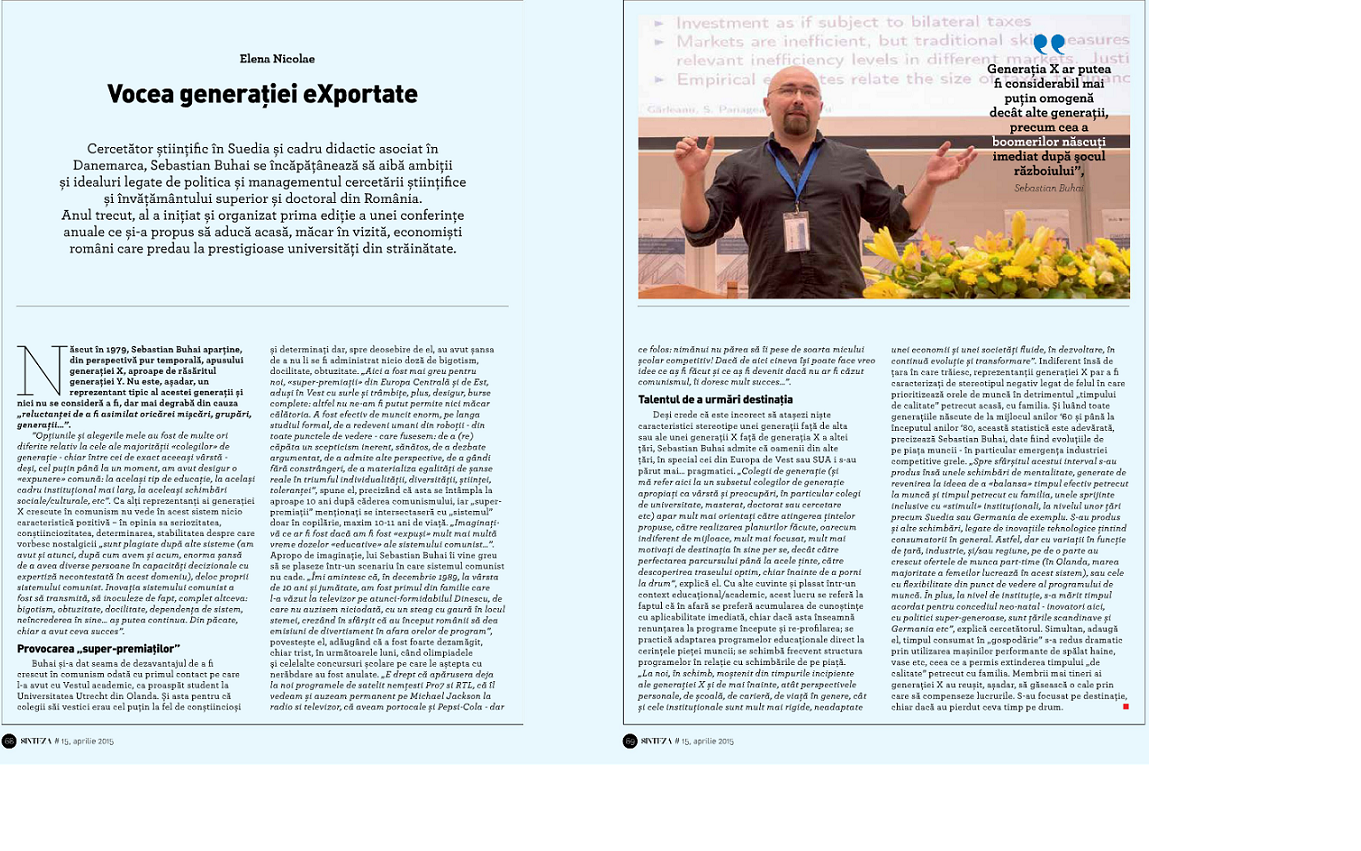
(158 bytes)“Despre Capitalism si Economie de Piata, in Varianta Contemporana” (“On Capitalism and Market Economy, in Contemporaneous Variant”), June 2018, prepared for the July-August number (nr. 53) of the Romanian cultural magazine “Revista Sinteza“. After an initial magazine embargo period, now you can also read Revista Sinteza’s ungated online  version (includes the diacritics specific to the Romanian languagewhich however seem to have introduced also a few typos, has nice formatting, great pics of Adam Smith and yours truly, but loses the footnotes/ bits of text from my initial PDF version linked above); the published version has also appeared online in “Jurnalul Bucurestiului”. This short essay discusses a contemporaneous perspective on capitalism and market economy, inter alia exploring the current role and scope of state and regulatory agencies interventions on the market, and at the same time invites the motivated reader to get a more in depth treatment by digesting two recent books by Luigi Zingales (2012): “A Capitalism for the People. Recapturing the Lost Genius of American Prosperity” and respectively Paul de Grauwe (2017): “The Limits of the Market. The Pendulum Between Government and Market” (listed also as references at the end of the essay).
  • pdfs.gif

(158 bytes)The Rise for Academic Integrity in Romanian (Domestic) Economic Sciences“, online on 4 Dec 2016. Co-authored by 9 Romanian economists from universities both abroad and inside Romania, this study—complementing an earlier analysis by Buhai, Litan and Silaghi (2015), see bullet point belowshows that in Romania (= an EU member, to put it into perspective) almost no academic economists meet basic international criteria for research quality, such that its research output in Economic Sciences, adjusted for quality according to (any usual) international standards, is half that of Africa’s average(!), below that of much more unfortunate countries such as, e.g., Cameroon, Uganda, Ghana, Nigeria… (not a joke, sadly). At the same time, the national evaluation/ promotion standards used in this field are fully out of line, such that even academics of global acclaim, including Nobel Laureates, John Bates Clark, or Yrjö Jahnsson awardees, would not *minimally qualify* for Econ professorships in Romanian univs (no joke either). Given that domestic criteria in place have been decided by individuals failing any international scientific standards, some of whom also violate academic ethic in other ways, and that those people continue to have influence over criteria to be set in the future, this is unlikely to change on its own. We therefore ask the global community of academics’ support for restoring sanity and decency to Economic Sciences in Romania, while calling on all domestic economists to rise for academic integrity and honor, for proper recognition of scientific values. The conclusions of this analysis have been commented by various mass media, including newspapers, radio, and news outlets; see my media coverage page for entries in December 2016 for such links. A large number of (foreign or domestic, including from other sciences) academics have already expressed dismay at the current state of affairs in RO Econ—for public reactions see, e.g., (re)tweets on the EconAcademia twitter in Dec 2016.
  • Initiating manifesto – in pdfs.gif

(158 bytes) Romanian and respectively, in pdfs.gif

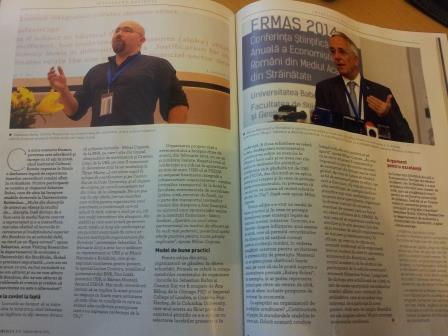
(158 bytes) English – for the 1st Edition of the Annual Scientific Conference of Romanian Academic Economists from Abroad (in Romanian: 1a Editie a Conferintei Stiintifice a Economistilor Romani din Mediul Academic din Strainatate= ERMAS), co-authored with Mihai Copaciu, Cosmin Ilut, and Cristian Litan, in December 2013. A brochure for that conference, gathering several documents (the manifesto, our call for papers, the final program, and the list of participants) can be accessed herepdfs.gif

(158 bytes) in Romanian or herepdfs.gif

(158 bytes) in English. Full details at conferinta.econacademia.net or, easier for only English speaking folks, at english.econacademia.net. We also wrote a short statement for the Romanian press underlining some of the expectations for this conference (many of them fulfilled, a posteriori). See also a pdfs.gif

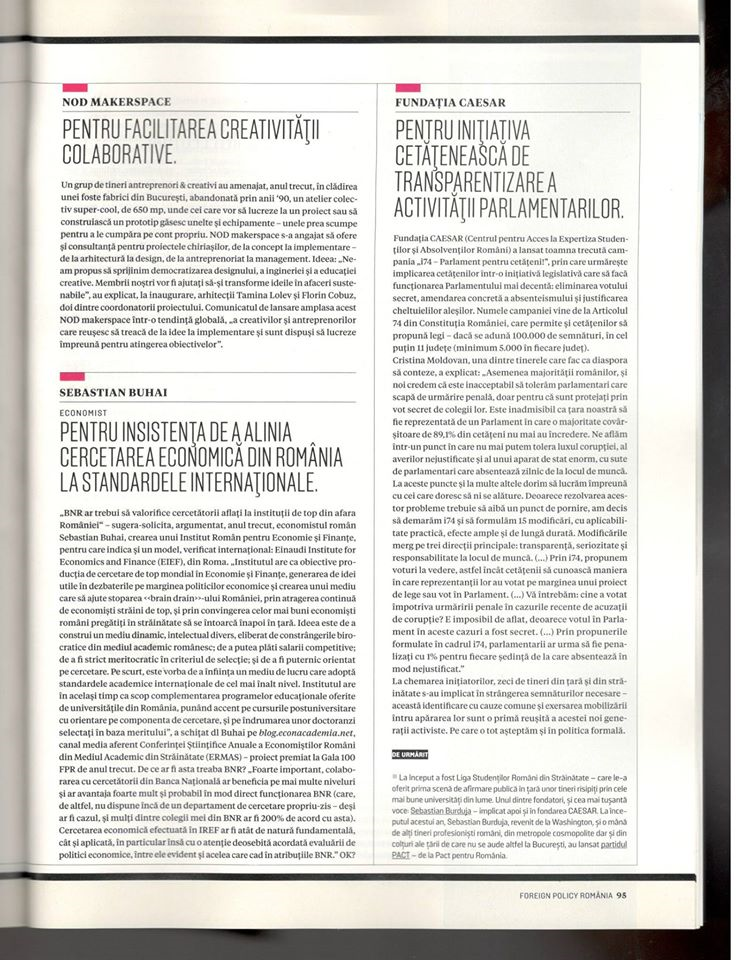
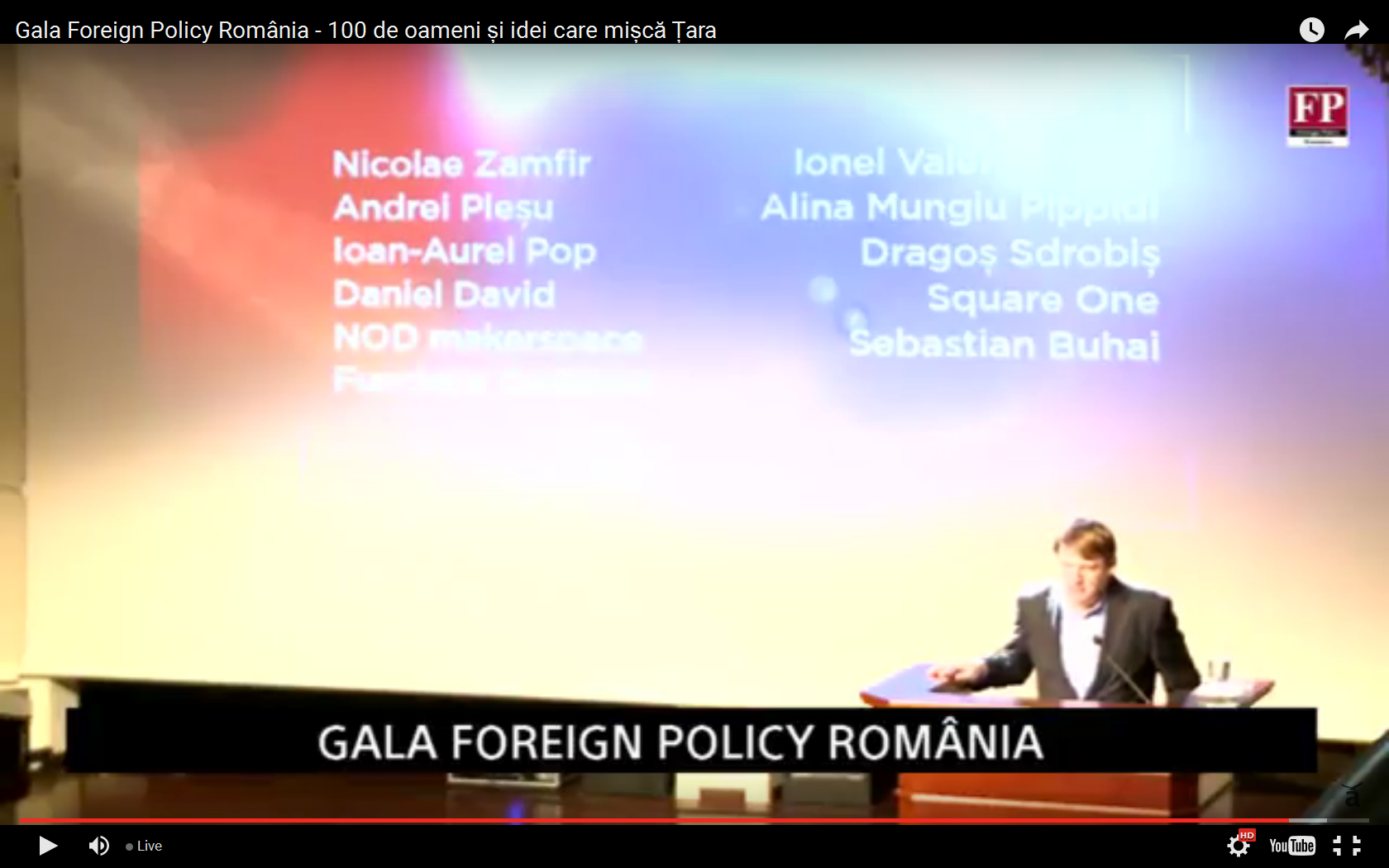
(158 bytes) PDF list with links to press coverage of the ERMAS 2014 conference and its aftermath (including press coverage of our being awarded one of the “Top 100: People and Ideas that Move Romania” Foreign Policy (FP) Romania Prizes, at the category “Ideas/Projects”, in early March 2015, for initiating this ERMAS conference).
  • pdfs.gif

(158 bytes) Detailed answers to what finally became an unpublished 10-questions “interview” requested by Romanian national newspaper “Romania Libera”, 10 February 2012 (in Romanian)
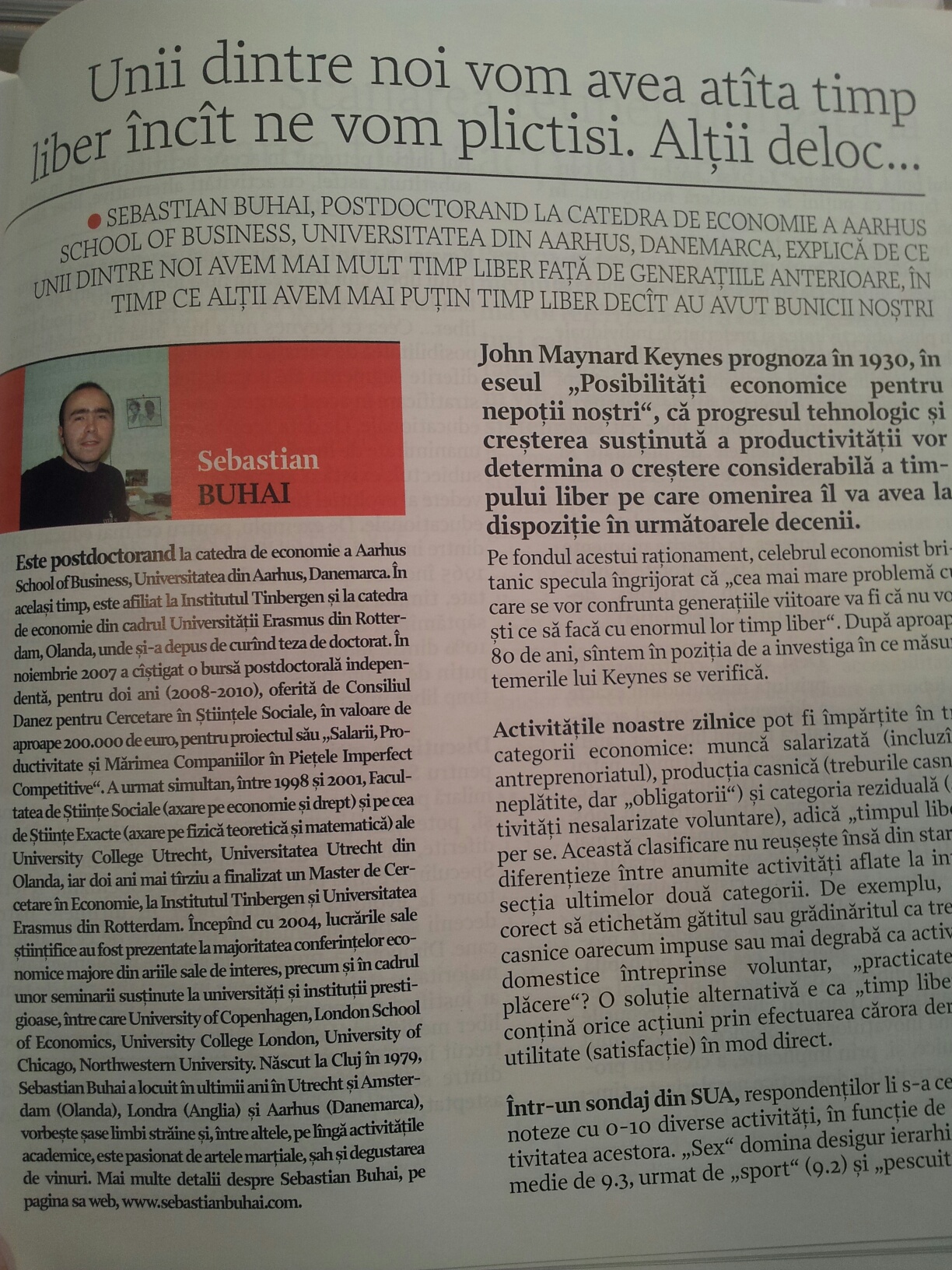
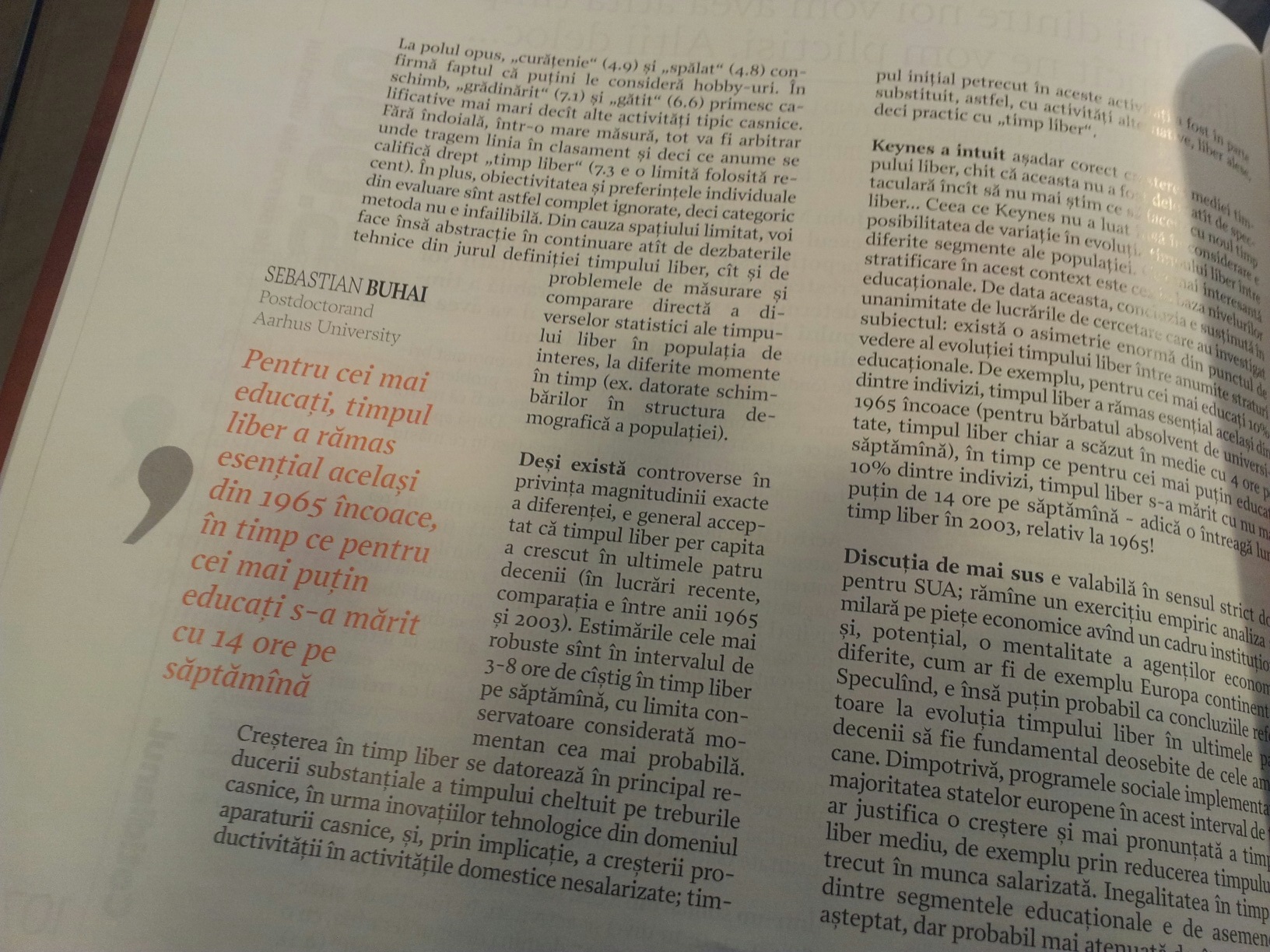
  • pdfs.gif (158 bytes) An article entitled “Unii dintre noi vom avea atâta timp liber încât ne vom plictisi. Altii deloc…” (this direct link to the article in Cotidianul online appears to have stopped working at some point, but use the link to the PDF copy from earlier) that I wrote for the Romanian newspaper Cotidianul in their series “5000 de  semne ale viitorului”, published on the 20th of April 2008 (some info about the series in this article by Alexandra Badicioiu). The article linked above also contains some biographical information (both the article and the information have been edited by the journalists from Cotidianul to fit the required space and the format). If the direct link above stops functioning properly, you have above a link to the version saved on my site. There are also some more details and further references to the article linked in the comments section of this post on my old blog. The whole series was then published in a companion book “5000 de semne ale viitorului”: scan of  front cover, first page of my article, second page of my article.
  • pdfs.gif (158

bytes) Scientific Colloquium of Romanian researchers in Denmark, at the residence of the Romanian Ambassador in Denmark, Theodor Paleologu, on the 10th of March 2007. I presented “Economia ca stiinta sau despre imperialismul economic intre stiintele sociale”; you can dowload the PDF presentation linked at the start of this paragraph (in Romanian). I talked a bit more about this colloquium on my blog (also in Romanian). And you can also find something about this event on the site of the Romanian Embassy in DK.

Selection of older essays/ presentations, published in various Romanian mass-media (online or in print format; click to download):

First some short articles (in unedited version) published within the Educational Supplement of the newspaper Gandul, on the lives of several Nobel Laureates (that section is actually called, in direct translation from Romanian, “the Nobel Laureates are also humans…”). I don’t know yet if I will continue with this series.

  • John Harsanyi: O Calatorie Incredibila sau “Daca Vrei cu Adevarat, Poti!” (You can also read this from my blog)- this has not been published in Gandul yet (or this is what I know, it sounds incredible but I am actually never informed whether something was published, will be published and so on- another reason why I am not sure whether it is worth continuing- my 100% voluntary- collaboration there).
  • Jan Tinbergen: Un Om de Stiinta Coborat din Turnul de Fildes (I posted this also on my weblog, here).
  • Jim Heckman: Independenta, Perseverenta, Excelenta. Punct si de la Capat… (You can also access it via my weblog)

I also published a short economic article (the most difficult part was to keep it that short) in the newspaper Cotidianul.

  • Snapshot Economic al Europei in Tranzitie: Noiembrie 2005 .You can also read it directly on their site (I also posted it on my weblog).

I wrote another article

  • Liber-Schimbismul,. Protectionismul si…Amatorismul

initially for the same newspaper Cotidianul but apparently they did not like it (I say “apparently”, since in fact I was never given a reason for “why not”, which is what I would have expected from rational people) so at the very end of the day I ended up just posting it on my blog. Well, who’s interested will find it, read it and- you’re welcome to, by the way- comment on it and on anything else that you find on this page.

I continue with the listing some articles that were initially published on the Romanian online independent portal “Romania, Libera in Viitor” (RLIV), within its weekly electronic publication called “ACUM” (you can find all other articles I wrote for RLIV-ACUM here), sometimes followed by their commenting or re-publication also in other mass-media outlets.

Highlights from RLIV-ACUM (especially articles concerned with science and research policy in Romania):

  • Perspectiva Candidatilor la Presedintie asupra Cercetarii, Stiintei si Tehnologiei. Exemplul SUA, Deziderat in Romania

My questions concerning the status of scientific research in Romania from the second part of this article (the essay was published here, in the RLIV-ACUM’s “Research, Science, Technology” (in Romanian: “Cercetare, Stiinta, Tehnologie”) section that I founded and maintained as editor until June 2005), inspired from the questions addressed by the prestigious journal Science to the USA presidential candidates and addressed to the Romanian presidential candidates in 2004, were publicly sustained by means of open letters, by the Ad-Astra Association of Romanian Researchers (in Romanian: Asociatia “Ad-Astra” a Cercetatorilor Romani), the Romanian Academic Forum (in Romanian: Forumul Academic Roman=FAR) and by several scientists of Romanian origin, including the Nobel Prize Laureate, Professor George Emil Palade. Some accounts in the mass-media and on the web sites of the organizations involved can be read in what follows: press communicate FAR, press communicates Ad-Astra, open letter signed also by Prof. Palade, other echoes in the Romanian mass-media: Evenimentul Zilei (also here and here), Ziua (also here), Romanian Global News (also here). Two of the Romanian presidential candidates answered the questions, Mr. Marko Bela and Mr. Adrian Nastase. A reaction of FAR to these two answers can be read here.

  • Renasterea Prestigiului Doctoral in Romania

This short essay is the result of a joint brainstorming of several Romanian scientists working in research outside Romania, voluntarily organized in a taskforce to help the Romanian Ministry of Education in its planned reform of the Romanian High Education and Research sectors- it summarizes imperative measures needed to reform the doctoral programs in Romania and to consequently contribute to the rebirth of the Romanian doctoral prestige. It was published here, in the section “Cercetare, Stiinta, Tehnologie” of RLIV-ACUM. Miruna Munteanu wrote an excellent article related to this document in Ziua.

  • Conditia Cercetatorului Stiintific: Intre Realitatea de Acasa si Idealul din Afara

I wrote this essay linked above for the conference “Migration of Young Romanian Researchers: Performances and Possibilities of Return”, organized by the Romanian Cultural Institute (Institutul Cultural Roman=ICR) in Sinaia,October 2004. The essay can be found on the site of the ICR, it was published also on RLIV-ACUM (here with the abstract in the beginning as well), and in the Ad-Astra Journal.

  • PDF Presentation of the paper “Conditia Cercetatorului…” (plus some other thoughts), at the Sinaia conference mentioned above

Some people in the audience totally disagreed with me, but that presentation seemed to be interesting (provoking?) enough to get me quite a few subsequent interviews for Romanian TV channels, radio, and press…

Other— random selection—articles published in RLIV-ACUM (selection):

  • Scurt despre Zei si Pamanteni in Context Autohton
  • Cum Clavis: Modul de Alegere a Viitorului Papa
  • Opinia Cititorului: Cu Trenul prin Romania. Partea a II-a
  • A Face o Diferenta
  • Noteaza-ti profesorii: www.calificativ.ro
  • Reflectii (Utopice) de Duminica Seara pe Tema Societatii Civile Active
  • Opinia Cititorului: Cu Trenul prin Romania
  • Cat de Fioros Este Leul Greu? Despre Implicatiile Denominarii Monedei Nationale din Iulie 2005
  • Consideratii Subiective asupra Retoricii Publice: Logos, Pathos, Ethos in Versiune Mioritica
  • Note de Trecere, Mizerii si Dogme
  • Elitele Autohtone: Conflict si Mediocritate (Pledoarie pentru Cooperare)
  • Plesu si Mancatorii de Sarmale
  • Un ecou la “Elementele Nonverbale…”
  • Ma-Ia-Hii, Ma-Ia-Huu, Ma-Ia-Hoo, Ma-Ia-Haa si Adevarata Muzica Romaneasca
  • Germania de Est: Popularitate Ingrijoratoare a Extremismului Politic
  • Performanta Economica a Presedintilor Americani in Perioada Postbelica
  • Talmaciri din Harry Mulisch: “Descoperirea Paradisului”
  • “Cercetare, Stiinta, Tehnologie”: O Rubrica la Inceput de Drum
  • 15 milioane de Oameni
  • Fahrenheit 9/11- FILMUL


Media Coverage

Mass-media coverage of Sebastian Buhai

Below you can check out a selection of press/ magazine articles and other news media, including television or radio talk-shows, where I have been interviewed/ covered (with saved PDF versions where possible—clicking around pdfs.gif (158 bytes)—should the direct links cease to function); although most articles are in Romanian, they have brief explanations in English below on this page (for newer items). Please note that the links are usually no longer updated/ rechecked after their initial posting. The starred ones Starredare larger contributions (longer interviews, live talk-shows, etc.). In reverse chronological order (and typically listed on this page with considerable time lag):

  • Starred PressHub.ro, 19 January 2026, or download simplified pdf copy (see also a tweet or a BlueSky post announcing this): Romanian MSM feature by journalist Ruxandra Hurezean, anchored in my essay “România care gândește: coloana vertebrală a unei administrații funcționale” (see also the corresponding bullet point, for January 2026, on my essays page). The piece distils for a wider audience the essay’s central wager: Romania does not primarily suffer from a shortage of diagnoses or good ideas, but from a shortage of testability and institutional discipline. In a policy ecosystem where analysis is optional, incompetence becomes survivable, and the cost of improvisation is socialised, reform devolves into rhetoric and committees become an alibi. PressHub highlights my proposal to reverse this equilibrium by building an independent analytical community that produces public, replicable output (not signatures), and that enforces standards through method, transparency, and reputational accountability rather than through “stamps” or local prestige. In short: we don’t ask for faith; we ask for verifiability—and for institutions designed so that the absence of evidence, counterfactuals, and ex‑post evaluation can no longer pass as governance.
  • Starred Adevărul, 29 December 2025, or download simplified pdf copy (see also a tweet or BlueSky post announcing this): national Romanian media feature by journalist Remus Florescu, anchored in my blog post “Reflecții de final de an despre România” and published in the newspaper under the headline “„Meteahna” care ucide România și e mult mai gravă decât corupția. Economist: „Expune statul la captură””. The piece distils, for a general audience, the core thesis that Romania’s binding constraint is often not the absence of diagnoses, but the absence of state capability: inter alia, thin data, weak procedures, discretionary administration, and fragile implementation chains can make corruption scalable, expose the state to capture, and turn policy into improvisation with recurring economic and social costs. It covers (partially) my essay “Stat și piață în armonie – cheia coeziunii României?” (see also the corresponding bullet point, for December 2025, on my essays page).
  • Starred Adevărul, 7 August 2025 or download simplified pdf copy (see also a tweet or BlueSky post): national MSM coverage (by journalist Remus Florescu from Adevarul, the most read RO national newspaper nowadays) of my essay proposing 10 strategic, counter-cyclical measures for Romania’s recovery, as counterpart to the current raw austerity—an evidence-based policy architecture balancing macro stability and social cohesion. These measures can be stratified along four axes: automatic stabilizers & fiscal equity; human capital, social & digital investment; labour-market activation & inclusion; and public sector capability & governance. The feature was subsequently picked up also by domestic outlets Capital.ro (simplified PDF copy) or Realitatea.net, among others. Based on my roadmap “Recalibrating Romania’s Economic Policies: Counter-cyclicality, Stability, & Social Inclusion” (PDF, companion blog post), see the corresponding bullet from my Essays page.
  • Starred TVP World “Bottom Line”, 8 July 2025  (in English): I joined TVP World, the international arm of Polish public broadcaster TVP, for a live, 15-min “Bottom Line” interview on Romania’s fiscal woes, hosted by Marie Kato and produced by Business Editor Jakub Kapiszewski (special thanks for the invite). We unpacked how Bucharest’s 9 %-of-GDP deficit teetered on the brink of an EU excessive-deficit procedure, only for Brussels, in a rare act of fiscal statesmanship, to grant Romania until 2030 to straighten its books, turning it into a live experiment in Europe’s discipline-vs-growth dialectic. Along the way, I deconstructed the emergency austerity playbook (e.g., VAT overhaul, wage freezes, excise levies and civil-service salary caps) and the entirely justified uproar from health and education workers. Yet true resilience demands more than headline cuts: it also calls for razor-sharp, structural, growth-friendly reforms—targeted, socially responsible public investment (no more “football pitches around trees”), labour-market liberalization, robust judicial overhaul, slick EU-fund absorption and a decisive pivot to a green, digital, human-capital-powered economy. Sadly, decades of breathtaking incompetence and entrenched corruption by essentially the same parties now in power have eroded any presumption of goodwill. I’ve been a relentless critic, inter alia publishing detailed blueprints and grilling presidential hopefuls with incisive, nationally amplified questions (see many earlier bullet points below or on my essays page), yet clear answers remain frustratingly elusive. My advice to co-citizens (and curious onlookers alike): trust but verify, and never let go of your healthy (academic and beyond) skepticism. Here you can watch the full segment as archived on TVP’s YouTube channel: “Romania narrowly escapes Hungary’s fate”. Some recap posts with links: tweet1, tweet2; BlueSky1, BlueSky2.
  • Starred Adevarul, 14 May 2025 or download pdfs.gif (158 bytes) copy (see also a tweet or a BlueSky post from then): a feature in this national Romanian newspaper, published by journalist Remus Florescu, spotlighting my open letter to then–presidential candidates Nicușor Dan and George Simion (see the original letter in PDF format, or alternatively in blog format), challenging them to move beyond electoral fireworks and engage with a concrete, strategic reform plan for Romania 2025–2030, which I briefly sketched for them. “Romania needs leaders who can govern, not just candidates fluent in campaignese,” I wrote, inviting them—civic to civic—to respond publicly and substantively, with verifiable answers built on full honesty, clear-eyed analysis, and civic responsibility. Neither candidate, regrettably, took the time to reply. A silence louder than any slogan. Because Romania deserves leaders who think before they dive into the shallow end of populism… Between the two presidential hopefuls, we may have eventually ended up with the relatively better option—but when the bar is this low, one wonders how high we’re really aiming.
  • Fanatik.ro, 14 February 2025 or download pdfs.gif (158 bytes) copy (also see my tweet or my Bsky post announcing it): a brief interview/ contribution for the Romanian online MSM Fanatik.ro, with Raluca Alexe redactor, on the costs of giving birth and bringing up a child in Romania, in the current context of sustained inflation. Hard to find well documented, concise essays on such important topics, written for wider audiences in the typical Romanian outlet, this being a rare exception.
  • Radio Romania Actualitati, 4 February 2025 see their initial note about it , and/or my tweet and my BlueSky post  announcing it: an approx 10-min live intervention at the Romanian national radio: Radio Romania Actualitati, within the popular program “Probleme la zi” (producator: Sorin Bejan, realizator: Alexandra Andon), briefly discussing Trump’s recently announced (and partly delayed) tariffs for Canada, Mexico, and China, with potential implications thereof for the global economy, international policy, etc. You can listen to that (phone) interview from about 27’20” on the recorded podcast available online in this archive (search for “Editia din 04-02-2025”); see also my tweet or my BlueSky post  also giving all these info/coordinates.
  • Starred Adevarul, 18 December 2024 or download pdfs.gif (158 bytes) copy (also see a tweet or a BlueSky post from then, announcing it): an interview in the Romanian national newspaper Adevarul, with Remus Florescu as interviewer, where I explain the contributions of the 2024 Laureates of the ‘Econ Nobel’ Prize, with some direct and indirect applications for current Romania (especially within the context of the cancelled 2nd round of the Presidential elections recently held in that country, and the significant uncertainty concerning its staying the democratic course). My last line from the interview is “Vegheați ca fotoliul prezidențial să nu se transforme în tron” (in English: “Watch out that the presidential chair does not turn into a throne”).
  • Interviews with myself and with other members of the academic/ scientific Romanian diaspora, ahead of the Romanian presidential and parliamentary elections — scattered over 4 separate published articles within the special weekend edition on “The Voice of the Diaspora”, 22-23 Nov 2024, of the RO national newspaper Adevarul (by journalists Remus Florescu, Ana-Maria Șchiopu & Dana Coțovanu): 1. on how the diaspora sees the electoral year in RO (or download a simplified pdfs.gif (158 bytes) copy); 2. on whether Romanians abroad would return home (or download simplified pdfs.gif (158 bytes) copy); 3. on whether the RO politicians respect the diaspora (or download simplified pdfs.gif (158 bytes) copy), and 4. on how 35 years of democracy have changed Romania, in the eyes of its diaspora (or download simplified pdfs.gif (158 bytes) copy). NB. I am, obviously, only responsible for my own views covered in here. See also a couple of tweets — here and respectively here — announcing those articles (attached to the tweets, some screenshots of my parts); finally, you can also see a collection of screenshots corresponding to all my contributions from the interviews in this google photos album.
  • Starred Adevarul, 28 June 2024 or download pdfs.gif (158 bytes) copy (also see tweet from then, announcing it): an interview in the Romanian MSM Adevarul, with Remus Florescu as interviewer, in which I briefly explain why the (re)introduction of a 6-day workweek does not have the potential to solve structural problems on the labor marketand may well be counterproductivewhether in Greece (which was preparing to enact it from July 2024), in Romania (as demanded by surprisingly many, following Greece’s example), or anywhere…
  • Panorama, 27 August 2023 or download simplified pdfs.gif (158 bytes) copy (& see also my tweet on that): an essay by journalist Răzvan Zamfir from online Romanian business/ economics magazine Panorama that contains, next to a couple of others’ perspectives, my view on some of Romania’s gravest economic errors within the last 3 decades (selected and exposed by the Panorama journalist from several of my earlier published essays/ interviews on these topics, and a brief recent correspondence with him). The Romanian title of the Panorama essay: “Marile greșeli economice care trag România înapoi de 30 de ani”.  NB. I am evidently only responsible for my own views and not for those of any of the other discussants in this piece.
  • PressOne, 26 June 2023 or download a simplified pdfs.gif (158 bytes) copy (see also a tweet first announcing that): a material containing, inter alia, the summary of my brief discussion with journalist Răzvan Filip from Romanian online MSM PressOne Romania on whether and when a policy of VAT reduction (but also of capping prices, more generally) for basic goods would make sense (highlighting in particular the IO perspective of that ongoing debate, which is both the most relevant and typically the most ignored), focusing on the context at that time in Romania. The title of R. Filip’s piece, in Romanian: “Reducerea prețurilor la alimentele de bază: o idee bună sau un instrument cu două tăișuri? Argumente pro și contra de la doi experți”. NB. Obviously, I am only responsible for my own answers/ ideas and not for those of the other invited discussant from the same essay.
  • Starred Adevarul, 7 February 2023 and/or download simplified pdfs.gif (158 bytes) copy (& see also a tweet announcing this): an interview in the Romanian MSM Adevarul (R. Florescu interviewer) in which I explained inter alia why a year after the Russian criminal invasion of Ukraine and the subsequent calling for and partial implementation of economic sanctions against the aggressor, Germany/ the EU economy more generally is surviving just fine w/out any Russian gas in spite of the doomsday “winter is coming” predictions from the Kremlin and their acolytes, as well as the many idiots from Germany/ EU/ elsewhere who couldn’t bring themselves to cease all imports of Russian energy on their own/ much earlier/ much more comprehensively and decisively. (Among the bullet points just below on this page, you can also search for related interviews from the same Adevarul newspaper in 2022, where I had argued for the imposition of sanctions and against doomsday economic fears.)
  • Starred Adevarul, 12 April 2022 (and/ or download simplified pdfs.gif (158 bytes) copy + see also my tweet announcing this), in Romanian: interview in Romanian MSM Adevarul, with Remus Florescu as interviewer/ editor, on (what-would-be-) the moral strategic and visionary decision (unfortunately without decision makers mature enough to take/ enable it…) of ceasing all imports of Russian energy in Romania (discussed also within the larger EU context); the price that Romania (or rather: its clueless, spineless, useless current political leaders) doesn’t seem so far to be prepared to pay is not more, in the worst possible case, than an average of about 80 euro/ capita, year (according to recent analyses by Langot and Tripier (2022) — which is very similar to Baquee et al (2022) or Bachmann et al (2022)– all of which I refer to in the interview)…  Here’s a short translated fragment to serve as conclusion/ main point of this interview: “Interviewer: What do you think is the price for not taking these measures [stopping all current RU energy imports]? Me: The price of inaction is the war crimes, massacres, horrors from Mariupol, Bucha, Borodyanka, Kramatorsk and the rest of Ukraine, many of which we have not yet heard of. Those who must decide and have not yet decided to do everything in their power to stop the Russians are complicit in these atrocities and will be judged as such by history. Interviewer: Do you think that Romania would benefit if it took the measure independently of the other European states? Me: Absolutely. It would be a moral, strategic, visionary act. But do we have leaders with these qualities? ….” This was a third interview in Adevarul about necessary economic sanctions on Russia in the context of the current invasion of Ukraine, see also the bullet points below on this page corresponding to earlier interviews on 11 Mar and 27 Feb.
  • Profit News, 4 April 2022 (between approx. 0.34-0.48) – or, for faster loading/ download, see just my own intervention here, separately saved on YouTube  (also about it on my twitter) – recording of a live interview on the RO national TV channel Profit News about some of the humanitarian and economic impacts of the Russian criminal invasion in Ukraine, with Raluca Al Haddad as interviewer/ moderator. It turned out that I had less time for this than I had thought I would have, hence eventually I just managed to gloss over the humanitarian crisis aspect (e.g., concerning the refugee inflow from Ukraine into the neighboring countries/ Europe more generally, the difficulties with coordinating/ allocating all that influx– inter alia, comparing with the previous Syrian refugee crisis that EU had to deal with–, while ensuring the basic, immediate needs for all those people), plus extremely briefly over the direct damages to the Ukraine economy/ infrastructure, the regional/ global effects in terms of propagating negative food supply shocks, etc.
  • Starred Adevarul, 11 March 2022 (downloadable pdfs.gif (158 bytes) copy, also my tweet about this), in Romanian: interview in RO national journal Adevarul, with Remus Florescu as interviewer/ editor, about the most efficient economic sanctions against Russia, e.g., cutting the almost €1 billion per day(!) at the time of the interview still transferred to Putin for energy imports (oil, oil derivatives, and gas), and the hypocrisy/ lack of vision of EU leaders (DE particularly) for not having already applied them — essentially continuing to finance Russia’s invasion of Ukraine, while at the same time decrying it… Referencing/ citing Luis Garicano + a bunch of recent studies on Russia’s depending on its energy exports, the effect of the eventual sanctions on Germany’s economy, etc. This interview was also extremely mediatized/ cross-promoted on several online news sites, as well as on various social media (NB. mea culpa for not having the time to address… or even read… the hundreds of questions/ comments raised on those sites, as well as to me individually…). See also the bullet point just below for an earlier interview on initial/ possible economic sanctions against Russia.
  • Starred Adevarul, 27 February 2022 (print simplified pdfs.gif (158 bytes) copy), in Romanian: interview in national MSM Adevarul discussing early economic sanctions applicable to Russia in order to compel it to desist and stop its invasion of Ukraine. Inter alia, this is about my being utterly amazed that the exclusion of Russian banks from SWIFT is still met with some reticence and that some of the more effective means within the full arsenal of possible punitive economic measures (including seizing the assets of Russian oligarchs supporting/ enabling/ financing the Kremlin) have to date not been seriously considered. There is absolutely no time to waste, and economic sanctions can be extremely effective to stop Putin’s criminal insanity before it scales up: if only decision makers (especially those from the EU states, many of which have a lot of commercial links with Russia) had/ found the, now sine qua non, long-term vision and leadership qualities! See also an EconAcademia tweet about this interview.
  • Starred Adevarul, 16 February 2022 (or download simplified pdfs.gif (158 bytes) copy), in Romanian; published interview in this major Romanian MSM, Adevarul (Remus Florescu interviewer), about Romania’s *total lack of* preparation/ even willingness in the fight against global warming/ transition towards a “green economy”, despite it being a signatory to the EU’s “Fit for 55” ambitious program; I have also discussed a bit about the lack of progress in this realm at the global level: COP26 an utter failure not unlike previous ones, with the first, “COP1”, of the fruitless yearly meetings already 3 decades ago this year… A considerably longer, unedited, earlier version of this interview is available on my blog (inter alia including much more on the economic instruments needed to fight climate change, many further references, answers to questions raised in the comments, etc). See also my tweets (thread) about the published version.
  • Profit News, 24 January 2022 (between approx. 0.37-0.51), or, especially for those with slower connections, you can see just my intervention here, placed on YouTube, recording of a live interview on the economics/ business- related RO national TV channel Profit News about minimum wages in Romania/ EU/ world, with Adriana Nedelea as moderator– see also about that via my twitter. Among others (but do listen to the interview, if you understand Romanian, there is more there), I’ve explained a bit why the debates around a decent minimum wage are misinterpreted outside the academic literature (in particular why in a realistic labour market monopsony/ oligopsony the usual– badly understood outside the academe– facts about the tradeoff between employment/ level of minimum wages in purely competitive markets *do not apply* to the same extent, or are even muted); why the Romanian minimum wages, even though they increased over the last 15 years, are still very low compared to what they ought to be for a decent society welfare — or compared to the rest of the EU, including some of our CEE neighbours (in addition: why people, including idiotic Ministers of Finance, confuse gross and net rates, even though in Romania with contributions shifted mostly to the employees since 2018 this matters greatly), why *complementary* socio-economic policies are obviously desirable but never *substitutable* to decent minimum wages — especially so in a country like RO, with high and increasing inequality, huge rate of poverty and risk of social exclusion, extremely low labour force market participation among some of the vulnerable groups, a huge and constantly growing workforce deficit, and weak and purely formal employer-employee collective negotiations; I’ve also discussed about the EU recent initiative of a directive on minimum wages, etc. NB. See also the links with interviews from below or my essays webpage for more information/ details on all these topics.
  • Profit News, 10 January 2022 (between approx. min. 0.34-0.49), or, better for those with slow connections, see here just that fragment alone placed on YouTube, recording of a live 15-min interview on the economics/ business- related RO national TV channel Profit News, with Adriana Nedelea as moderator (see also a sequence of announcements about that via my twitter). I’ve discussed, among others: facts concerning the current Romanian labour market (e.g., disparities regarding labour force participation by age, gender, education; large and pandemic-exacerbated earnings inequality, etc.); projections concerning the envisaged future of the labour market, on the background of the population ageing, automatization/ digitalisation, decarbonisation/ transition towards a greener economy, including the sectors/ occupations/ jobs most in demand; how (dis)connected are the current education/ training and the expected labour market skills (with some detail on the disastrous situation concerning basic know-know relevant to the digital economy/ society dimension); the total lack of competence/ preparation/ even interest of the Romanian policy maker concerning social, health and education policy (with focus on a specific case, typical of the general chaos reigning there: they’ve ex post realised that *nobody* internally employed at the Authority for the Digitalisation of Romania, newly inaugurated part of the RO Ministry of Research, Innovation and Digitalisation, had any, whatsoever, training/ competence to even *understand* what they need to do to fulfill the objectives stipulated in the large ‘digitalisation’ chapter of the NextEU plan for economic recovery and resilience); general recommendations concerning competencies and skills to try to acquire, for both younger generations and older participants on the labour market, etc.
  • Starred Adevarul, 4 January 2022 (or simplified pdfs.gif (158 bytes) copy on my website), in Romanian, an interview in this major MSM, Adevarul, entitled “Joburile viitorului: ce se cere pe piata muncii in urmatorul deceniu in Romania si de ce nu suntem pregatiti” (en: The jobs of the future: what is on demand on the future labor market in Romania in the next decade and why we are not prepared for that). I’ve answered questions about some of the projections concerning jobs/ occupations which will be on the greatest demand within the next decade (inter alia, discussing about the forecasts of the US BLS, McKinsey, or the World Economic Forum in that regard), as well as on the skills/ competences needed for that. One particular domain, of serious concern in Romania given its current status quo, is the digital competences register, but also the general adult/ life-long education (the lowest within the EU, for instance). For more details and an unedited version of this published interview with Remus Florescu, you can also read this blogpost, which also links to some of my previous interventions concerning the Romanian labour market (see also twitter announcement).
  • Starred Adevarul, 8 December 2021 (simplified pdfs.gif (158 bytes) copy on website), in Romanian, also announced on my twitter: an interview in one of the Romanian main newspapers, Adevarul, about the large and by now long-lasting workforce deficit in Romania (and not only in Romania—though in Romania/ Eastern Europe this problem is arguably much older than in other parts of the EU, or the USA, not just a recent post-pandemic restriction phenomenon, etc.), at all skill levels, as well as what are some of the potential solutions, at both corporate and public policy level, to solve or at least alleviate that problem (with thanks for the questions and the final edit to journalist Remus Florescu).
  • Starred Adevarul, 24 November 2021 (simplified pdfs.gif (158 bytes) copy on my website), in Romanian, see also on my twitter: an interview with Remus Florescu for Adevarul, one of the main national newspapers in Romania, entitled “Viitorul muncii este hibrid” (=”The Future of Work is Hybrid”). I’ve answered some questions concerning the spread/ dynamics of telework (pre- and especially since the Covid-19 pandemic), zooming in on EU/ Romania, and trying also to forecast a few trends for the future in this context. Among others, it is obvious that telework is here to stay and shape the structure of future labor markets, including, indirectly, for sectors where it cannot be readily utilized (for instance, by shortening the duration of the working week); at the same time, particularly with respect to knowledge-intensive industries and occupations, it is also clear to me that the enormous positive externalities of face-to-face interaction will not be substitutable too soon.
  • Starred FinEco24News, 8 November 2021 (simplified pdfs.gif (158 bytes) copy on my website), in Romanian—see also short description on twitter: wide-ranging discussion on Norel Moise’s popular “FinEco24News” blog (N. Moise is the chief editor of ‘Piata Financiara’, well-known Romanian economic & finance MSM) about, among others, Romania’s consumption-led, unsustainable economic growth; its striking inequality, poverty, and social exclusion problems; its 3-decade long twin deficit dilemma, on the background of the continuous, staggering decision makers’ ignorance and incompetence; the potential impact of the NextGenerationEU package on the Romanian economy, though plenty of vagueness and incoherence in the plan for economic recovery and resilience (particularly egregious is, e.g., the climate/ environment chapter) submitted by Romania to—and somehow, barely, eventually approved by— the EU Commission; the sheer absurdity of funding/ governance pertaining to scientific research and more generally R&D in my birth country; what we have learnt/ should learn from the ongoing global supply chain crisis and the need for strategic industrial policy; etc. This interview was also publicized by the Business Report of HotNews, as well as other outlets.
  • Starred HotNews, 28 October 2021 (simplified pdfs.gif (158 bytes) copy on my website), in Romanian—see also a short description on twitter, at the time of its publication: an interview on HotNews.ro (major Romanian MSM), with Ramona Florea as interviewer, about my perspective on the notion of “respect” in general (it even includes a tad moral philosophy 1.0.1 flavour!), as well as respect applied in more specific contexts, such as respect for work in Romania (got quite specific on work environment conditions/ satisfaction with them in RO vs elsewhere); or respect for economists/ economic education in Romania (which domestic “economists”? will the real economists please stand up?… who should and who can teach/ disseminate economics in RO? who should be hailed a public intellectual among these “economists” and economists?…  can you trust an “economist” Prime-Minister who hasn’t got a clue about the price of a loaf of bread? or an “economist” Minister of Finance who doesn’t know the minimum wage in his country? how about the zillion econ “professors” and “academicians” in my fascinating country of birth who never published in any scientific outlet that you ought to care about?…)
  • VICE Romania, contributions to two interesting essays by Stefan Alin Dragomir about socio-economic systems then and now, inter alia debunking some myths and other widely held beliefs, published on 20 August 2021 (titled “Ce nu înțeleg acei români anti-capitaliști când se închină la Marx și comunismul lui Ceaușescu”) and respectively on 13 September 2021 (titled: “Am vorbit cu tineri români care vor să salveze lumea de capitalism”), see also my short twitter announcement on this latter one. NB. Those interested to read more about the economic dimension of capitalism can also consult this older, short essay of mine on that theme (referenced also in the first essay from Vice mentioned above), also aimed for a general audience.
  • Starred HotNews, 10 August 2021 (simplified pdfs.gif (158 bytes) PDF on my website), in Romanian (see also short description on twitter, at the time of the publication): ample, wide-ranging interview/ discussion with Dan Popa on HotNews.ro (a major Romanian MSM) about, among other things, the impact of the Covid-19 pandemic on various personal and aggregate dimensions; why one should vaccinate anti Covid-19; the (inexistence of relevant) Romanian domestic economic research; even about some recent recommended books and movies (linked to the other points raised in the interview): among others, I’ve praised and strongly recommended recent econ-based books for a general audience by Dani Rodrik, Jean Tirole, or Christian Gollier. NB. This interview has also got plenty of references to other material, including to older interviews that can be also found below on this page, or to essays/ articles that can be found on other pages of my website.
  • Starred VICE Romania, 27 May 2020, 45 min live interview in Romanian on their instagram, as part of their series “Expertul VICE” (VICE RO interviewers/ hosts Cosmin Pojaranu and Razvan Baltaretu); see also my twitter announcements (with links) related to this event, from 26 May and 27 May. Among other things (all chosen by VICE Romania or sent in by their audience) I briefly tackled: the type of economic crisis originating with the Covid-19 pandemic; the economic impact of the Covid-19 pandemic in Romania (and elsewhere) and economic policies to mitigate it; (the—specific and general—unsuitability of) Universal Basic Income; sustainability of fiscal debt and pensions; personal finance, in the crisis and beyond, etc.
  • Starred Adevarul, 6 May 2020 (saved pdfs.gif (158 bytes) PDF on my website), in Romanian (see also a short description on twitter): the third and last of the separately published parts of my ample interview about the economic impact of the Covid-19 pandemic and measures to save/ restart the economy (interviewer: Remus Florescu) given on April 13 2020, this chapter was entitled “The EU coronabonds would be one of the most efficient instrument of the UE to fight the pandemic crisis; Germany’s attitude in that respect not only egoistic, but puerile” (translation of the original title in RO).  Inter alia, I tackled in this bit of the interview the largely unjustified “inflation phobia” (particularly great among decision makers in Romania); the necessity of rethinking globalization, in particular with accent on the strategic value chains (something that the Covid-19 pandemic highlighted very clearly) and on compensating those negatively affected (something clear since ever, but never properly addressed); and the expected, but so far little materialized, leader role of the European Union in this crisis (in many ways this being a test for the solidarity the EU was projected to stand for, and which Jean Monnet had so clearly and unequivocally emphasized). This interview part was actually published so much later than the date of the interview per se (13 April), to be closer to the Europe Day on May 9 (unfortunately, just days before, the German constitutional court managed to give another blow to what European solidarity ought to mean, in any language…).
  • Starred Revista Sinteza, 4 May 2020 (saved pdfs.gif (158 bytes) PDF on my website), in Romanian (see also short twitter description ), long and wide-range interview (interviewer: Ruxandra Hurezean) entitled: “A big advantage of the current pandemic crisis is that it is not structural” (translated from RO).  Among other things I discussed my impression of Paris under the pandemic; asymmetric effects of the pandemic crisis—including the amplification of the existing social inequality, in several dimensions; how to think of (modern times) fiscal deficits in general, and under the current crisis; will there be a food crisis linked to this pandemic crisis and how can we think to manage that, if so; what are the necessary steps to relax the confinement/ social distancing measures so far, and what are the currently proposed solutions/ plans ahead to restart the heavily hit economies. The interested reader can also deepen his/her perspective by consulting the further references I offered in this interview.
  • Starred Adevarul, 28 April 2020 (saved pdfs.gif (158 bytes) PDF on my website), in Romanian (see a short twitter description, also in RO): a second published out of three successive parts of an ample interview (interviewer: Remus Florescu) given on April 13,  entitled “The lesson of the previous pandemics: the social distancing/ pandemic containment measures are justified both medically and economically” (paraphrased from the tile in original Ro); this part is about what we know (and what sometimes we ignored) from the study of previous pandemics, a general discussion about the mechanisms through which the pandemic crisis affects the economy, and the policy measures most economists currently agree on to alleviate the negative shocks, and to restart the economy once that is possible. I also gave plenty of further references for details/ specifics regarding most of my arguments put forward in this interview.
  • Starred Adevarul, 26 April 2020 (with saved pdfs.gif (158 bytes) PDF on my website), in Romanian (see also a short description on twitter also in RO): the first of three separately published parts of an ample interview (interviewer: Remus Florescu) that I had given on April 13 (chronologically, this was the *third* part of the interview…)—  entitled “Forget about the 60% public debt rule or the 3% fiscal deficit rule: when Covid-19 knocks at your door, these do no matter any longer” (translated from the original title in Romanian), this is essentially about (some of) the economic effects of the Covid-19 pandemic inside Romania, with discussion of the policy measures taken up to that date by the RO government, and that in comparison with what other European states (including Romania’s Eastern/ Central EU neighbors) had done. In particular, I mentioned the many misunderstandings of the RO government in power (a clique with close to zero competence in economic policy, and a merry-go-round group of ‘advisers’ who proudly describe themselves as Austrian economists—though fail to understand even what that niche entails), resulting in a chaotic (euphemism) management of the crisis so far, on the background of already very bad management of the country prior to the crisis, in several respects. Luckily, at least the social distancing measures were taken relatively early in the crisis.
  • StarredStirile ProTV, 19 April 2018 (includes video material)with saved PDF pdfs.gif (158 bytes) version of its transcription—realized by Cosmin Savu: “Evaluarea unuia dintre cei mai importanţi economişti români: “Suntem pe la jumătatea Africii”“. This is a more detailed continuation/ expansion of the interview bits included in the Romanian national ProTV- “Romania, Te Iubesc!” program’s “Economie, Caut Strategie” edition from a few days earlier (see the bullet point below), with further excellent discussion points raised by my interlocutor Cosmin Savu; inter alia, we briefly covered the dismal state of the scientific research in Economics in Romania, the role/ reception of the ERMAS academic conferences in Economics, the (pervasive lack of) academic integrity in Romania, the under- or badly- utilised resources in academeand in the economy more generally, the general incompetence and/ or special interests aiming the capture of rents rather than improving productivity/ welfare, etc.  The transcribed material was also covered/ adapted/ summarized subsequently by other media, e.g.:  monitorul.com.ro, bzk.ro, portal-ro.comstiriziare.com, xgc.ro, etc.
  • “Romania, Te Iubesc!” at Stirile ProTV, 15 April 2018 (45 min video material), by Cosmin Savu: “Economie, Caut Strategie!”. Together with others (academics, politicians, managers, workers, etc.), I was interviewed for this superlative edition of the well-known, popular investigative program “Romania, Te Iubesc”, of the national Romanian TV channel Pro TV, this time interpreting/ discussing the overall state of the Romanian economy, with focus on the sheer incompetence and general lack of any viable strategy/ vision at governmental level (since 1989 and until today…), and that despite a few success stories at the level of some industries or particular companies. You can watch my interventions in the video linked above from minutes 31 and respectively 41 or, separately structured within the (partly transcribed) third part of that programsaved PDF version of that transcript; you can also see a couple of separate photos from that video-interview (NB. the youtube version linked here does not appear to work any longer; see instead the main link to the entire 45 min program, from above). This 3rd section of the program, mainly tackling the loss of the country’s qualified human capital, was subsequently covered/ adapted/ summarized also by, among others, extranews.ro, bzk.ro, informateca.ro, reporterromania.ro, or stiriactuale.ro. The “Economie, Caut Strategie” edition of ProTV’s “Romania, Te Iubesc” program was number 1 in the overall TV audience top, of that day.
  • StarredHotnews, 10 April 2018saved PDF pdfs.gif (158 bytes) version – by Dan Popa: “Sebastian Buhai, cercetator roman in Stockholm, ridica o intrebare simpla: e normal ca un laureat Nobel sa nu poata trece de criteriile impuse de autoritatile universitare romanesti pentru a preda la noi? De ce suntem la pamant cu cercetarea economica?“. This is a very good (and very swift!) sum-up for the popular national news site Hotnews of the second part of a talk I gave at the Bucharest University of Economic Studies (Academia de Stiinte Economice Bucuresti, in Romanian), about the truly parallel (i.e. parallel not only to excellence and merit, but even decency…) universe in which Romanian research in Economics finds itself, a consequence of the (dis)incentives implemented at the national level by those who do not have any interest for it to prosper. Partly based on two reports by myself and others: Buhai et al (2016) and respectively Buhai, Litan and Silaghi (2015) – see also the links to the press materials immediately below for other coverage of those-  and an intensive mini-course I gave at the Advanced Institute for Science and Technology of Babes-Bolyai University (UBB-STAR) in Cluj, Nov 2017, the Hotnews material was also covered/ adapted/ summarized by Romania24.net, TheWorldNews.net, StiriZiare.com, ZiareLive.ro, etc.
  • StarredPiata Financiara, 28 February 2018saved PDF pdfs.gif (158 bytes) version – by Moise Norel (see also the cover of that edition): “Cercetarea economica romaneasca ne plaseaza la jumatatea nivelului Africii” , an interview (within an excellent series of interviews on the Romanian Econ academe initiated by Moise Norel: see a couple of those within the “leadership” category of Piata Financiara) on the absurd state of domestic Romanian research and education in Economics (to a large extent based on this report/ manifesto by Buhai et al, 2016), and on attitude and aptitude (or rather: lack of those…) in managing/ organizing scientific research and higher level education in Romania, more generally (see also a grouping of several press interviews with me on that same topic, on my blog). In the end of that interview I also offered my very brief (in-a-tweet!) recipe for what I think my country needs in terms of a viable academe, economy, and society.
  • StarredActual de Cluj, 15 August 2017saved PDF pdfs.gif (158 bytes) versionby Kristina Restea: “Din grupul economiştilor care au declarat război imposturii în mediul academic din Romania, tara unde premianţi de Nobel nu au loc în Universităţi. Sebastian Buhai, cercetător român la Stockholm: “Vorbim de o lume paralelă, asta e şocant!””. This interview with excellent questions by journalist Kristina Restea takes on, inter alia, expected eventual changes in the Romanian academic system following our Buhai et al (2016) report and manifesto: “The Rise for Academic Integrity in Romanian (Domestic) Economic Sciences” (see also the 4 Dec 2016 entry on my “essays” page for further details; for other extensive coverage in the Romanian mass-media about that report please see below on this “media coverage” page the entries dated 14 Dec 2016 and 6 dec 2016); the Actual de Cluj article was also taken over, in various formats, by, among others, InsideCluj.ro, Romania24.net, CentruldePresa.ro, PortalZiare.ro, I-ziare.ro, Index-stiri.ro, etc. Unfortunately, despite the extensive media coverage and the thumbs up from many academics (economists and beyond) inside and outside Romania, Romanian decision-makers in context did not do almost anything to address and correct the absurdities (inter alia, “academic prostitution” is but an euphemism to picture what is asked from our economist colleagues inside Romania to be successful and to promote within the current system) that we pointed out in that report (as well as in reports from previous years, e.g., this one…). Surely then, the show *must* go on and, hopefully, many more will join in our (velvet) revolution!
  • StarredLive 30-min interview on Look TVthe “Casa Poporului” program hosted by Ciprian Aron, 1 August 2017, about the persistent, ubiquitous, to-many-unbelievable-but-sadly-real problems of the Romanian university/ academic system concerning Economic Sciences (and not only), and about initiatives meant to help, such as, e.g., the ERMAS annual conferences, etc. No link online appears to be available, but see some pics.
  • Actual de Cluj, 26 July 2017, by Kristina Restea: “Ce fac economiştii din diaspora în ţara unde laureaţii de Nobel nu au loc în universităţi“, about the ERMAS (2017) conference and its contribution to bringing back to life Economic Sciences in Romania; taken over, under various formats, also by Hotnews.ro, Fluierul.ro, Roportal.ro, Instrainatate.ro, etc.
  • Adevarul, 24 April 2017, by Remus Florescu, “„Marşul pentru Ştiinţă” în ţara în care se fac analize economice bazate pe numerologie. Cum poate fi România „reparată”—with expanded comments about this Romanian ‘march for science” also on my blog.
  • Comments/ consultation for various articles published in the national newspaper “Romania Libera” or by the Romanian Center for Investigative Journalism (CRJI), January-November 2017, mostly by the investigative journalist Sorin Semeniuc, about cases of plagiarism and other violations of academic ethic among Romanian dignitaries: Isarescu: 23 Jan 2017 and 25 Jan 2017Tranca & Matei: 31 Jan 2017; Grindeanu: 3 Feb 2017; the “doctorate factories” inside several Romanian ‘academies’: 21 Mar 2017; Serban Nicolae I: 21 May 2017  (on the same topic, see also Starea Natiei,  16 May 2017, from min 10); Tudose: 4 Jul 2017; Enache: 30 Aug 2017; Serban Nicolae II: 22 Nov 2017, CRJI.
  • StarredAdevarul, 14 December 2016—saved PDF pdfs.gif (158 bytes) versionby Remus Florescu, “Cercetarea economică din România, sub cea a ţărilor africane. Revoluţia „de carton“ a CNATDCU: „poţi în continuare candida cu lucrări în hernie abdominală“”. If the previous bullet point (6 Dec 2016 entry) tackled coverage of Buhai et al (2016)‘s main findings (see also my essays page, 4 Dec 2016 entry), this interview focuses on what was achieved through the national CNATDCU-ECON’s newly voted criteria (on 5 Dec), subsequently signed into law by the then-Minister of Education & Research (on 20 Dec). Short answer: almost nothing (even this tiny, malformed, redundant ε is likely to die young, given the new RO Gov and particularlyironically from the perspective of our studythe new educator-and-researcher-in-chief). Florescu’s article has also been distributed by, e.g., Antena.ro, Baleares.ro, Fluierul.ro, Ziare.com, ZiaruldeIasi, Portal-ro.com, Infoziare.ro, etc. Despite media exposure and vehement scientist reactionsmany public or directly sent to CNATDCUthe pseudo-scientific, incumbent Econ nomenclature has again chosen to sacrifice academic decency, at the expense of the RO Econs’ long-term well-being, and of the RO academe’s/ society’s welfare more generally. The saddest is that utter failure affected even decision-making technocrats expected to fully grasp our study’s implications (after all already obvious from my mediatised earlier studysee below); this was ex post reconfirmed, e.g., by an amazingly bad (albeit some ok parts) interview with M. Andruh, CNATDCU head and, unlike others therein, a qualified scientist (fast reactions here, here, here, or here). What now?… Do not forget, do not forgive, relentlessly pursue (the Romanian dream of) academic integrity & scientific performance: we shall overcome!
  • StarredPressOne, 6 December 2016with saved PDF pdfs.gif (158 bytes) version—article by Bianca Felseghi, entitled “Laureații Nobelului pentru Economie nu întrunesc criteriile pentru a fi profesori în România”. This is a good commentary in Romanian—including additional answers I gave to the journalist—of some of the main aspects of a paper written in English by myself and eight others, Buhai et al (2016): “The Rise for Academic Integrity in Romanian (Domestic) Economic Sciences”; see my “essays page” the 4 Dec 2016 entry, for details. In a nutshell, RO Econ Sciences are, in terms of quality-adjusted research output, at 1/2 of Africa’s (!) level, while criteria for evaluating performance therein are out of touch with sanity, s.t. even Econ Nobel Laureates would not minimally qualify for professorships: we call for a rise against the regime which enacted & continues to defend this imbecilic state of affairs. Felseghi’s PressOne commentary of our study was subsequently featured in a comedy show by Europa FM, a national radio broadcaster, as well as summarized/ distributed by other media outlets, such as Money.ro, Cultural.bzi.ro, Antena3.ro, Ziare-pe-net.ro, Ziarelive.ro, personal blogs, etc. Some public reactions from foreign/RO scientists have been collected as “retweets” on twitter EconAcademia (Dec 2016).
  • StarredAdevarul, 23 September 2016with saved PDF pdfs.gif (158 bytes) versionby Remus Florescu: “Cercetător român la Universitatea din Stockholm, despre învăţământul din ţară: „În România, un doctor în economie nu mai înseamnă, din păcate, nimic“”. This is the 2nd part of an interview in Adevarul on the implications of Buhai, Litan and Silaghi (2015): “Disincentiving the performance: the case of the Romanian national criteria in Economic Sciences” (English abstract), now specifically about wider, societal consequences, and about what was done, and what to do about the truly inane status quo in RO domestic Economic Sciences; see the bullet point entry for 19 August 2016 below for the 1st part of this interview. This Adevarul article was disseminated also through Antena.ro, Gazetarul.ro, Nmedia.ro, ZiaruldeIasi, Roportal.ro, ZiareLive.ro, Ziare.com, etc. Read also an overview on my blog: “Despre universuri paralele in evaluarea performantei in cercetarea economica”, with reader comments covering both interview parts from Adevarul.
  • Romanian Center for Investigative Journalism (CRJI), 12 September 2016, by Sorin Semeniucsaved PDF versionon the plagiarism of “academic experts” (here, one of many losers w/out any expertise from the national decision-making CNATDCU body) appointed to assess alledged plagiarism by other ‘wannabe academics’ (here, a hapless former RO Minister of Internal Affairs), ubiquitous in my country… I am quoted in a paragraph at the end of this article stating that plagiarism in RO is the tip of the iceberg (RO journalists care only about plagiarism), the problems of academic misevaluation, awarding of titles and perks, and promotion/proliferation of pseudo-values being widespread and more important for both academe and societyas I & co-authors have shown for Economics (see my ‘essays page’ or relevant bullet points on this page).  This gets eventually back to who is to set standards, who is to evaluate “evaluators”? My sine qua non is that any “evaluators”, any decision-makers such as CNATDCU members, have to be *internationally* acknowleged as relevant in the academic profession, and w/o the slightest trace of ethics violation. The CRJI article was covered also by 7est.ro, Nasul.tv, ReporterIS.ro, ZiareLive.ro, etc.
  • Digi 24 TV: “Starea Natiei”, 31 August 2016, minutes 39-43: no less than 4 min allocated on a popular national Romanian TV comedy show hosted by Dragos Patraru, to the subject of  ERMAS, disincentiving scientific performance, and the Romanian Rahova Institute of Technology. For foreigners: get someone to translate that clip for you, since it scores reasonably high on the fun scale (albeit with tragic nuances for RO Econ academics, and eventually for the RO society). This was again popularising some of the findings by Buhai, Litan and Silaghi (2015)see also the previous bullet point.
  • StarredAdevarul, 19 August 2016with saved PDF pdfs.gif (158 bytes) versionby Remus Florescu, in Romanian, entitled “Economistul genial considerat „şansa României la Nobel”, profesor la Oxford şi la Sorbona, nu e suficient de bun şi pentru a preda la o universitate din ţară” (the journalist’s title might appear exaggerated, but is meant to capture the paradox as vividly as possible…). This is a press material commenting the Buhai, Litan and Silaghi (2015) studysee also my ‘essays page’ for the entry dated December 2015about the absurd, fully inane national criteria of evaluation/promotion in Romanian domestic Economic Sciences, embodying a universe parallel to both scientific excellence and academic mere decency, given international standards for this field; it contains further interview QAs. This was further disseminated under various formats (summary, commentary) by other outlets, including B1.ro, Business24.r0, Wall-Street.ro, Alternativenews.ro, StirileKanalD.ro, Antena.ro, Realitatea.net, Gazetarul.ro, ZiaruldeIasi, Ziare.com, Sputnik.md, 9am.ro, etc. The ERMAS 2016 conference press coverage also contains selected links. Read also the corresponding post on my blog: “Despre universuri paralele…”, with reader comments and reactions.
  • StarredAdevarul, 18 April 2016, with its saved PDF pdfs.gif (158 bytes) version, an article by Petre Munteanu entitled “100 FP Romania/ 2015:- what was relevant in terms of Ideas & Projects: academicians, historians, politologues, psihologists, economists, entrepreneurs” (RO: “100 FP Romania/ 2015- ce a fost relevant in materie de Idei & Proiecte: academicieni, istorici, politologi, psihologi, economisti, antreprenori”), with info on the new FP Romania Laureates “Top 100: People and Ideas which Move Romania”category Ideas/Projects, including my own listing there; the bullet point below has more details.
  • StarredForeign Policy Romania, nr. 50, ed. Feb/March 2016, available fully only in print, in Romanian; see the relevant page scan (see also the category screenshot from the FP Romania Top 100 Prize Gala in March 2016); an article with detailed information about all the 2016 FP Romania Laureates “Top 100: People and Ideas which Move Romania”, including my own listing there under the category “Ideas/ Projects”, and the entry “Sebastian Buhai, economist: For the Insistence to Align Economics Research in Romania to International Standards ”  (in original: “Sebastian Buhai, economist: Pentru Insistenta de a Alinia Cercetarea Economica din Romania la Standarde Internationale”). More specifically, I was listed in this FP Romania top 100 for a proposal that the Romanian National Bank (BNR) starts a Romanian Institute for Economics and Finance (“Institutul Roman pentru Economie si Finante”=IREF), analogous to the Bank of Italy-initiated EIEF and respectively the Bank of Spain-initiated CEMFI.  This was my 2nd consecutive listing in the Foreign Policy Romania Top 100, in the previous year being listed, together with 3 colleagues, in the same “Ideas/ Projects” category—and then actually winning the category’s prize—for initiating the ERMAS conference (see corresponding links below).
  • Adevarul, 14 December 2015, by Remus Florescu, in Romanian, with the title “De ce esueaza reformele Educatiei: spiritul de turma si centralizarea puterii. Trasaturile lumii academice romane incompatibile cu modelele occidentale”, summarizing conclusions of the 2015 Report of the G3A Think Tank on Romanian academic/research policies, where I and two co-authors contributed an analysis on the dismal situation of Economic Sciences within Romania (read the abstract in English, entitled “Disincentivizing the performance: the case of the Romanian national criteria for evaluating research in Economic Sciences”)
  • Press release of the National Bank of Romania (BNR), 5 October 2015: the BNR Governor’s speech in a ceremony rewarding BNR researchers admitted to present papers at the Annual Conferences of Romanian Academic Economists from Abroad (ERMAS), which I together with 3 colleagues initiated in summer 2014 (see further links below for various prizes/articles related to this conference).
  • StarredLive 50-minute interview/ discussion on the Romanian TV channel Digi24 (Cluj-Napoca), “Vocile Clujului” rubric, with Marius Benta as — superlative — moderator, 28 July 2015. If easier to access, now you can also see this interview on YouTube. In this talk-show, entitled “Economist din diaspora: Cercetarea de top este posibilă în Romania”, I have discussed some of the steps that need to be taken in Romania in order to eventually reach excellence in terms of scientific research and graduate education status quo, with focus on Economic Sciences (arguably, Economics has one of the sorriest state among all sciences represented in my country). Inter alia, my advice for my co-nationals was to plagiarize… yes, to plagiarize!… but with a twist: they need to stop- and punish properly- plagiarizing scientific papers or PhD theses as currently habitual even at governmental levels in Romania, and instead copy/plagiarize/emulate the organization/management of scientific research and graduate education from e.g., US, UK, Western Continental EU. The large and reasonably successful community of Romanian academic economists from the diaspora is ready to help, but our colleagues from within Romania have to be prepared to listen carefully and act… before further generations are lost. To read comments subsequent to that talk-show see my corresponding blogpost.
  • StarredAdevarul, 17 June 2015 (with saved PDF pdfs.gif (158 bytes) version), in Romanian: under the (translated from Romanian) title “A Romanian economist from the diaspora challenges Mugur Isarescu [Governor of the National Bank of Romania=BNR hereinafter]: BNR should capitalize on the top Romanian economists from outside the country“, this is Remus Florescu’s well adapted version of an article I initially wrote for Blog EconAcademia (blog of Romanian academic economists that I initiated and co-founded in December 2014), proposing that BNR sets up a research institute in Economics similar to the Einaudi Institute for Economics and Finance (EIEF) from Rome (founded by the Bank of Italy), revolutionizing the current, dismal status quo of the research and graduate education in Economics from inside Romania. The Adevarul article has been taken over by other online (news) sites, such as Gazetarul.ro, Comisarul.ro, RadioIntact.ro, Fluierul.ro, Ziare.ro, etc.
  • Starred“Sinteza- Revista de gandire si cultura strategica”, number 15, April 2015, in Romanian (available fully only in print; see imperfect fast-scanned version): adapted interview with me by Elena Nicolae, nicely entitled (by her) “The voice of the eXported Generation” (in original “Vocea generatiei eXportate“). I discussed briefly and generally about the Romanian ‘Generation X’ and how I fit in that, including my impression of Romania under Communism, the Romanian December ’89 revolution, my experience of studying/working outside Romania from very early on, etc.
  • Adevarul, 4 March 2015 and Adevarul, 6 April 2015 (with saved pdfs.gif (158 bytes) PDF versions, pdf_4March2015 and respectively pdf_6April2016), in Romanian: 2 articles by Petru Munteanu with the list/description of the 2015 Foreign Policy (FP) Romania Prizes “Top 100: People and Ideas which Move Romania” (=”Top 100: Oameni si Idei care Misca Romania”); I have been awarded the 2015 FP Romania “Top 100” Prize– jointly with Mihai Copaciu, Cosmin Ilut and Cristian Litan– within the category “Ideas/Projects” (=”Idei/Proiecte”), for our initiating the Annual Conferences of Romanian Academic Economists from Abroad (“ERMAS” as Romanian acronym). The more recent article linked here is an ‘extended version’ of all those listed within the “Ideas/Projects” category of the 2015 FP Romania Top 100; starts with my colleague Mihai Copaciu’s photo receiving the category prize on our behalf, in Bucharest, 3 March 2015.
  • StarredForeign Policy Romania, nr. 44, ed. Feb/March 2015 (available only in print; a relevant PDF pdfs.gif (158 bytes) fragment), in Romanian: an article with detailed information about the 2015 FP Romania Prizes “Top 100: People and Ideas which Move Romania”, including the prize that I and 3 other colleagues have won for initiating the ERMAS conference, within the category “Ideas/Projects”, see also the bullet point immediately above. This article was mentioned, inter alia, also in a press communiqué of FSEGA, Babes-Bolyai University, superlative hosts of the very first ERMAS edition (you can also check out a compilation of various news media about the 1st ERMAS conference edition, including on this FP Romania Top 100 prize).
  • StarredAdevarul, 1 January 2015 (with saved PDF pdfs.gif (158 bytes) version), in Romanian: interview in this newspaper’s cycle “Romani cu care ne mandrim” (=”Romanians who make us proud”), published in the very first day of the new year(!), in which I answered questions about my recent initiatives concerning Romanian academic economists, about my best research published in 2014, and offered my New Year wishes for Romania.
  • StarredAdevarul, 12 November 2014 (with a saved PDF pdfs.gif (158 bytes) version, in case the link stops working), in Romanian. An article by Remus Florescu, slightly adapting my questions on science/ research/ education policy addressed to the Romanian presidential candidates from the 2nd election round, November 2014 (this article gathered more than 1800 “likes” online on the Adevarul website, after just 1 (one) day since publication). The initial material embedding these questions appeared on my blog (where you can also read comments and my reactions to them). These 2014 questions are, in fact, identical to the ones I have addressed to the then-ROpresidential candidates a decade earlier, in Nov 2004 (e.g., see below on this media-coverage page, around November 2004; search also my essays page for documents from around that date), when they were also sustained by several associations of Romanian researchers, and individually by some of the top Romanian scientists from abroad, including the Romanian Nobel Prize winner George Emil Palade; then, in 2004 (as, sadly, now in 2014) few of the presidential candidates bothered to answer anything (and none replied concretely and/or to the point; for some of those 2004 documents, candidate replies, etc, consult a sum-up by the Ad Astra Association of Romanian Scientists), and, unexpectedly, nothing significant changed in terms of science or education policy in my country, which still performs below any other EU countries and way below its potential. This article from Adevarul appeared also on Yahoo News Romania or Comisarul de Cluj.
  • StarredForeign Policy Romania (FPR), October-November 2014 edition– appeared in print 6 october– (so far only in print; in Romanian). The print edition has my short bio (with some errors, e.g., missing again one of my university degrees, but overall fine) on page 8- glimpse here– and an interview, taken by Raluca Maxim, on pages 40-41, entitled Repatriere stiintifica. La ce pot fi buni acasa economistii romani validati in centre de cercetare majore din lume” , glimpse here. See also the index of topics from this FPR edition.
  • Starred‘Sinteza- Revista de gandire si cultura strategica’, number 8, September 2014 edition (only in print; in Romanian), ample material by Elena Nicolae in the ‘Intelligent Business’ section– under my headline “Noi nu ne-am saturat de Romania” (which appeared also in one of my interviews mentioned below on this page, about 10 years earlier)– covering the ERMAS 2014 conference, based on interviews with myself, Mihai Copaciu, Cristian Pop-Eleches, Nicolae Garleanu, Virgiliu Midrigan and Mihai Manea. A glimpse of this Sinteza material (Sinteza’s journalists took pretty nice pictures!).
  • VoxPublica.Realitatea.net, 22 August 2014 (in Romanian) pdfs.gif (158 bytes), an article-analysis by Ciprian Domnisoru.
  • Adevarul, 21 August 2014 (in Romanian) pdfs.gif (158 bytes) This material from Adevarul was also taken over by Yahoo News Romania.
  • StarredAdevarul, 20 August 2014 (in Romanian) pdfs.gif (158 bytes). (Flattering) Article by Remus Florescu (from its very title: “Mintile sclipitoare ale Romaniei care schimba economia lumii. De ce nu s-ar intoarce acasa”), based on interviews with myself, Mihai Manea and Nicolae Bogdan Garleanu (NB: the article has got some relatively minor errors — such as missing one of my academic education degrees, etc.– but overall is written well and obviously with noble intentions :-)). This article also appeared and/or was mentioned/ adapted on Wall-Street.ro, Comisarul.ro, Romania20.org or Momentozero.eu.
  • Actual de Cluj, 19 August 2014 (in Romanian) pdfs.gif (158 bytes)
  • Digi24 Cluj-Napoca, 18 August 2014 (in Romanian), with short video interview about the ERMAS 2014 conference (following after Mugur Isarescu and Cristian Pop-Eleches in the linked videoclip). The content of the article appeared also on Yahoo News Romania.
  • Hotnews, 14 August 2014 (in Romanian) pdfs.gif (158 bytes)
  • StarredLive 50-min dialogue on Romanian TV channel Digi 24 Cluj, 23 July 2014, together with Cristian Litan, and Marius Benta from Digi. If easier to access, now you can also watch this discussion on YouTube. The talk show was about ERMAS 2014 (18-22 August, Cluj-Napoca, Romania), i.e., the first edition of the Annual Scientific Conference of Romanian Academic Economists (“Conferinta Stiintifica Anuala a Economistilor Romani din Mediul Academic din Strainatate” in Romanian), which I have initiated and co-coordinated, including about its objectives, participants, near and far future, and related discussions about the Romanian scientific research, etc. All materials about the conference can be consulted on conferinta.econacademia.net (look for the PDF documents, available usually in both Romanian and English). These documents are also be accessible from my webpage with miscellaneous (non-research) essays.
  • StarredLive 50-min discussion on Romanian TV channel Digi24 (Cluj-Napoca), rubric “Vocile Clujului”, together with Marius Benta and Razvan Florian, 3 April 2014. If easier to access, now you can also watch this dialogue on YouTube. Inter alia, Razvan and I discussed about the current status of research and research policy in Romania, concrete ideas/ chances of bringing back or collaborating with the best Romanian scientists abroad, my involvement with the 1st Annual Scientific Conference of Romanian Academic Economists from Abroad (ERMAS 2014), and even… Salvo Montalbano, in the Romanian academic context :-). For some background in these discussions you may also want to read this essay on the condition of the Romanian scientific researcher that I wrote in 2004, or this other essay with questions addressed to the Romanian presidential candidates also in 2004, both mentioned in my Digi 24 interview (more such materials can be consulted here). And, of course, not sufficiently discussed in this interview, feel free to browse my and some of my enthusiastic Romanian economist colleagues’ initiative, Econacademia.
  • Contributors.ro, 18 December 2013 (in Romanian) pdfs.gif (158 bytes), article by Virgil Iordache.
  • Tinbergen Institute Magazine #27, Fall 2013 (in English) pdfs.gif (158 bytes) See page 8 of this PDF.
  • Hotnews.ro, 18 February 2013 (in Romanian) pdfs.gif (158 bytes) With the program of this RUSMG (the best I could do at the time in terms of a general name/ acronym :-)) workshop (in English) pdfs.gif (158 bytes)
  • StarredRomanian Embassy in Denmark website, 6 October 2012 (in Romanian) pdfs.gif (158 bytes) See also the full YouTube video record of the 6-10-12 BRAINetwork event that was mentioned in this article (my address starts about 33m30s – in Romanian; the subtitles in English are mostly fine, but not always correct).
  • StarredEVENTUALLY UNPUBLISHED 10-question interview in Romania Libera (the journalist who wanted to interview me, Petre Badica, seemingly changed his mind after I sent him– true, rather late: the excuse is that we have also other things to do in academia– the answers), 10 February 2012 (in Romanian) pdfs.gif (158 bytes)
  • StarredLive 40-min dialog on Romanian TV channel TransilvaniaLive.ro (former NCN.Ro), within the “Ziua de Zece” rubric (with Marius Benta and Sabin Gherman), 22 December 2011: I could not retrieve this online yet, will post a link here once I do. I discussed, inter alia, about the European Union labour market and Romania in this context, including labour market restrictions still kept by some of the EU Member States, North-South labour market differences in the EU etc. (in Romanian)
  • StarredLive interview on Romanian TV channel NCN.ro, within the “Cluj Zi de Zi” rubric (Ciprian Aron interviewer), 2 September 2010 (in Romanian): link1, link2 (my interview is the last of that day, starts about 94’30”). The interview was mainly about the status of the Romanian education and scientific research (e.g., recent education reforms of the Education Minister, Daniel Funeriu etc.), comparison to other European systems and to the USA etc. (in Romanian)
  • Flacara, 20 January, 2009 (in Romanian) pdfs.gif (158 bytes)
  • StarredCotidianul, 20 Aprilie, 2008 (in Romanian) pdfs.gif (158 bytes)
  • StarredNoua revista Cultura, 9 March 2006 (in Romanian) pdfs.gif (158 bytes)
  • StarredInternal University Press, Aarhus School of Business, 23 February 2006 (in Danish) pdfs.gif (158 bytes)
  • StarredCotidianul, 26 October 2005 (in Romanian) pdfs.gif (158 bytes) (see also a note from the “Catavencu Media Group” about this pdfs.gif (158 bytes) )
  • Timpul, 5 May 2005 (in Romanian) pdfs.gif (158 bytes)
  • Ev. Zilei interview with then-Ad-Astra director Razvan Florian, 23 November 2004 (in Romanian) pdfs.gif (158 bytes)
  • Forumul Academic Roman, comunicat de presa, 22 November 2004 (in Romanian) pdfs.gif (158 bytes)
  • StarredZiua, 19 November 2004 (in Romanian) pdfs.gif (158 bytes)
  • StarredCultura, November 2004 (in Romanian) pdfs.gif (158 bytes)
  • StarredRomanian Global News, 16 November 2004 (in Romanian) pdfs.gif (158 bytes)
  • StarredRomanian Global News, 3 November 2004 (in Romanian) pdfs.gif (158 bytes)
  • StarredAdevarul, 19 October 2004 (in Romanian) pdfs.gif (158 bytes)
  • StarredElsevier, October 2004 (in Dutch) pdfs.gif (158 bytes)
  • NRC, 2 April 1999 (in Dutch) pdfs.gif (158 bytes)

Projects & Links

Some of Sebastian Buhai’s Other Projects and Links

[my public photo/ video galleries online]
Flikr Sets, Twitter Media, YouTube Channel

[blog.sebastianbuhai.com]
Check out my personal blog.

[my social media online]
Check out/ follow my Twitter (X) feed.
Check out/ follow my BlueSky feed.
Check out/ follow my Mastodon feed.
Check out/ follow my Threads feed.

[econacademia.net]
I initiated a portal for RO Academic Economists.

[ERMAS]
I initiated an annual conference for RO Academic Economists.

[blog.econacademia.net]
I initiated a blog for RO Academic Economists.

See also a bunch of random links from my older website, which I should (re)organize as soon as possible… or not.

News & Musings

Herein below you can read/ access my latest posts from the BlueSky and Twitter (X) platforms (the custom Twitter (X) feed updates with a substantial lag and sometimes chaotically). You are obviously better off reading/ following me directly on Twitter (X) and/or on Mastodon and/or on BlueSky and/or on Threads for full functionality. (NB. The latter three platform feeds, unlike Twitter (X), are readable also if not logged in on the corresponding platform.)


Granting agencies: when you give your most prestigious grants to people whose publication lists are padded with irrelevant—if not outright nonsensical—papers, and fund projects to produce more of them, you're not funding excellence; you are laundering mediocrity through prestige.

Aptitudini, atitudini etc...

Twitter feed video.
Mircea "Wimbredon" @MirceaBan76

Domnu Mugurel de la @bnr_ro, alte banci centrale sunt moarte după cercetarile astea, voi ni’ca? A, stai..

𝑀𝑖𝑡 𝑑𝑒𝑟 𝐷𝑢𝑚𝑚ℎ𝑒𝑖𝑡 𝑘𝑎̈𝑚𝑝𝑓𝑒𝑛 𝐺𝑜̈𝑡𝑡𝑒𝑟 𝑠𝑒𝑙𝑏𝑠𝑡 𝑣𝑒𝑟𝑔𝑒𝑏𝑒𝑛𝑠.
În mintea mea, verdictul e clar: amice, ești idiot… Dar, într-o dezbatere serioasă, prostia nu se combate. Se lasă să depună mărturie contra ei însăși.

(credit lui Schiller și Cipolla)

Every time I discuss the economic and social disruptions caused by the worldwide decline in fertility, I hear the same response: artificial intelligence (AI) and robots will make this issue irrelevant.

I find the answer deeply paradoxical because, despite being an economist, I

This is what @ShengwuLi calls “informed neutrality” between reasonable ethical principles in the following fantastic paper, a perspective also reflected in minimalist market design. Indeed, economists are in a unique position to formalize these issues.

Image for twitter card

Ethics and market design

Abstract. This paper examines the relationship between ethics and market design. It argues that market design should ...

academic.oup.com

@ben_moll Very interesting read. I think there are two important gaps though:

First, this overstates how much the bottleneck was ever just writing the paper. In serious empirical work, the scarce inputs are still good questions, credible identification, access to data, institutional

Au Château de Chantilly, la crème n’est pas que dans l’assiette : elle est dans l’air, sur les toiles, au galop. Le Nôtre a tracé les jardins ; le Musée Condé garde les chefs-d’œuvre. Notre famille y a goûté l’histoire... et l’excédent du consommateur fut délicieux! Prix d’ombre.

Building off my announcement last week, I'm excited to share that we now have a Lean proof of the 24-dimensional case! This remarkable formalisation was completed with the help of @mathematics_inc's tool Gauss. Grateful to my collaborators and the community for all your support!

Load More